

Global shares slip ahead of weekly US jobs data
Global shares are down ahead of a report that is expected to show that weekly layoffs in the U.S. remained stuck at a high level since the viral pandemic erupted five months ago
By
YURI KAGEYAMA AP Business Writer
August 13, 2020, 12:00 PM
3 min read
TOKYO — Global stocks mostly fell on Thursday ahead of a weekly U.S. unemployment report that is expected to show that layoffs remained stuck at a high level since the viral pandemic erupted five months ago.
Jobless claims have been totaling about 16 million lately, with weekly numbers of people seeking unemployment checks growing to levels unseen since the Great Depression of the 1930s. Though the rate of applications for unemployment benefits has reached its lowest point since March, it has exceeded 1 million for 20 straight weeks — well above the record high that predated the pandemic.
On Wall Street, futures for the Dow and S&P 500 were both down 0.1%. In Europe, France’s CAC 40 shed 0.2% to 5,060, while Germany’s DAX dipped 0.2% to 13,030. Britain’s FTSE 100 lost 1% to 6,216 after some stocks began trading post-dividend.
Hayaki Narita at Mizuho Bank in Singapore warned against excess optimism about the U.S. economy, despite moderating numbers of new coronavirus cases and progress toward development of a vaccine that might help restore normality in a world encumbered by quarantine restrictions and fear of contagion.
“Encouraging signs of U.S. COVID curve flattening alongside vaccine hopes are reason for cautious optimism, not unbridled exuberance,” he said.
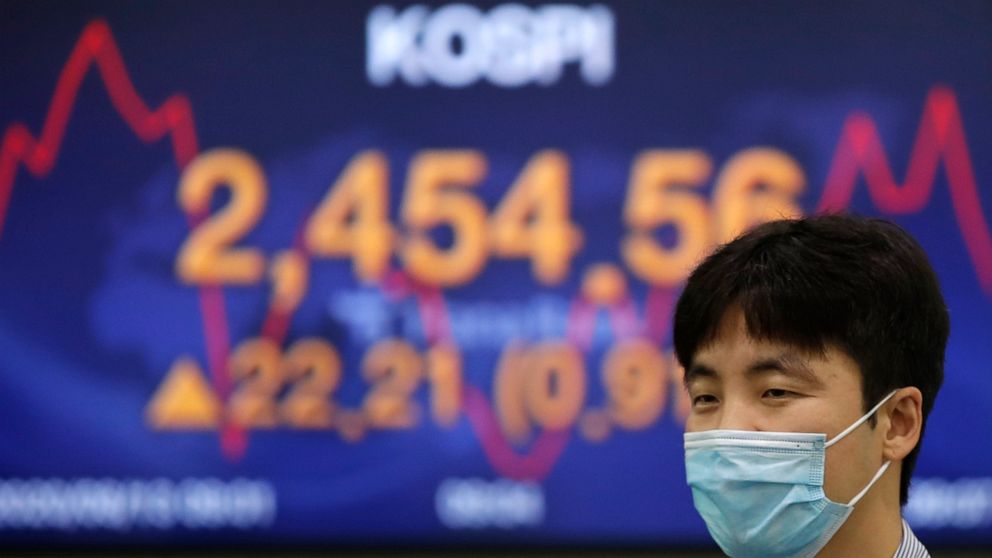
In Asian trading, Japan’s benchmark Nikkei 225 jumped 1.8% to finish at 23,249.61. South Korea’s Kospi gained 0.2% to 2,437.53. Hong Kong’s Hang Seng was little changed, slipping less than 0.1% to 25,224.93, while the Shanghai Composite index gained less than 2 points, to 3,320.73.
Australia’s S&P/ASX 200 lost 0.7% to 6,091.00, despite better than expected unemployment data for July. The number of jobs added was more than forecast and the unemployment rate was 7.5%.
“So while this employment report is a broadly positive piece of economic data, the Australian labor market is still under severe stress following the COVID-19 pandemic,” said Robert Carnell, regional head of research for Asia-Pacific at ING.
Trade tensions between the U.S. and China are adding to uncertainties, with officials from both sides due to hold a virtual meeting Friday to discuss progress on a deal reached in January that brought a truce in a tariff war.
In other trading, benchmark U.S. crude slipped 2 cents to $42.65 a barrel in electronic trading on the New York Mercantile Exchange. It rose $1.06 to $42.67 a barrel on Wednesday. Brent crude oil fell 10 cents to $45.33 a barrel.
The dollar rose to 106.97 Japanese yen from 106.89 yen. The euro rose to $1.1837 from $1.1764.