

4 projects that could be funded by the infrastructure package
The federal money will be allocated through a variety of programs, mostly run by the US Department of Transportation. Some of the funds will be disbursed directly to state transportation agencies, and other monies will be awarded to selected applicants through competitive grant programs.
The legislation does not name any specific projects that will receive funding, but here are four that will be seeking federal money.
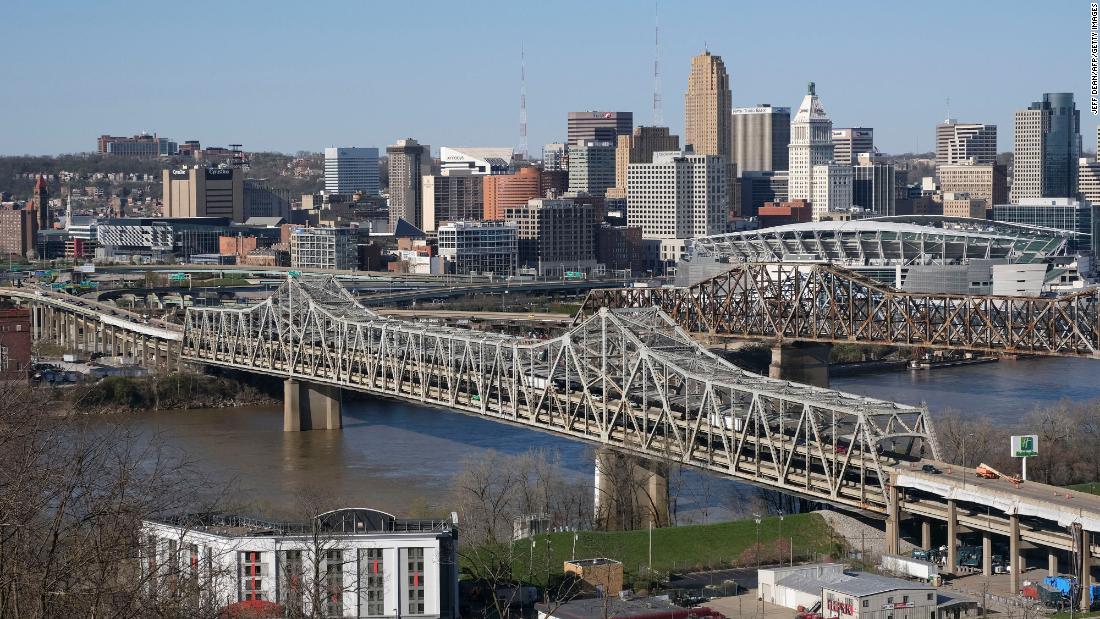
Brent Spence Bridge: Fixing a Midwest artery
The Brent Spence Bridge passes over the Ohio River to connect Cincinnati, Ohio, with Kentucky and is key to trucking goods from Florida to Michigan along an interstate corridor. But it’s also known as one of the most congested bridges in the country.
A $2.7 billion plan calls for keeping the Brent Spence Bridge and building a new bridge directly next to it, alleviating traffic around the Cincinnati region. The proposal has been on the shelf for years and the design is ready to be implemented, said Mark Policinski, CEO of the Ohio-Kentucky-Indiana Regional Council of Governments.
“The feds are finally standing up and saying we will pay our fair share. For projects like this of national importance, it’s only right they should be paying,” he added.
It’s likely that federal funds would cover a portion of the cost, with states and localities also chipping in.
Expanding public transit outside Atlanta
A federal investment could jump-start plans for what’s known as a bus rapid transit system outside Atlanta, estimated to cost about $1 billion. The buses would run in dedicated lanes free from other traffic. One proposal would create a lane along the Georgia State Route 400 corridor, running north of the city toward one of the fastest growing subregions in the Atlanta area. Another lane is proposed south of the city, along the South Fulton Highway.
“We know what we need. We’ve studied it, but we’ve been struggling to find a way to fund these plans,” said Liz Hausmann, a Fulton County commissioner and transportation committee chair for the National Association of Counties.
Improving the Chicago rail hub
Chicago is the nation’s busiest rail hub, with nearly 500 freight trains and 760 passenger trains passing through the region daily. About 25% of US freight rail traffic moves through Chicago.
About 30 of the projects are complete, but a boost in federal investment could help advance the multimillion dollar 75th Street Corridor project that’s currently underway. It aims to alleviate congestion at one of the biggest choke points in the system.
The project includes moving one rail line above ground, constructing a new commuter line and allowing some trains to access LaSalle Street Station instead of Union Station, freeing capacity at the latter for increased Amtrak service.
“We’re looking to untangle the spaghetti bowl of the bottleneck,” said Jennifer “Sis” Killen, superintendent of the Cook County Department of Transportation and Highways.
She said a new grant created by the infrastructure legislation, the National Infrastructure Project Assistance Program, could help fund projects just like this one that are multi-jurisdictional and of national significance.
Upgrading the Port of Baltimore
“We’re definitely going to aggressively pursue grant programs resulting from the bipartisan infrastructure bill,” said William P. Doyle, executive director of the Maryland Port Administration, in a statement sent to CNN.
The Maryland Port Administration may also seek funding provided in the bill for dredging projects. Dredging helps maintain the 50-foot depth of the port’s channels so that they can accommodate large ships. The dredged sediment is used to rebuild eroded islands in the Chesapeake Bay.
Doyle also noted that a pilot program included in the bill allowing 18- to 20-year-olds to drive tractor-trailers across state lines could help alleviate supply chain backups and move cargo in and out of the port more quickly.