

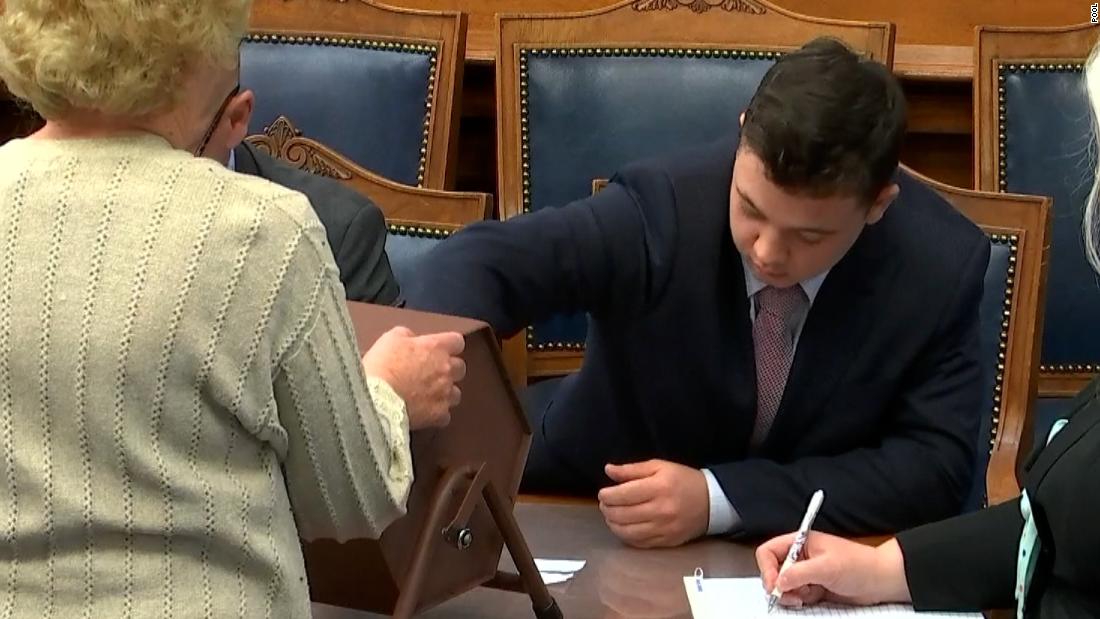
Jury deliberations in Rittenhouse’s trial continue today. If convicted, he could face life in prison
In addition, defense attorneys on Monday filed a motion for mistrial with prejudice in the trial, accusing the state of intentional “prosecutorial overreach.” The seven-page defense motion, obtained by CNN on Wednesday, relates to the prosecution’s line of questioning during Rittenhouse’s testimony last week as well as concerns about video evidence.
“I didn’t do anything wrong. I defended myself,” he testified.
Rittenhouse is charged with five felonies: first-degree intentional homicide, first-degree reckless homicide, attempted first-degree intentional homicide and two counts of first-degree recklessly endangering safety. Jurors are also able to consider lesser offenses for two of the five counts. If convicted on the most serious charge, Rittenhouse could face a mandatory sentence of life in prison.
Defense motion for mistrial with prejudice
Rittenhouse’s defense team on Monday filed a motion for mistrial with prejudice — meaning the trial would end and there would be no chance for a retrial.
In the first incident, the judge sent the jury out of the room and then warned Binger his questioning could be a violation of Rittenhouse’s right to remain silent under the Fifth Amendment of the US Constitution. Schroeder initially called the discussion of the defendant’s silence a “grave constitutional violation,” but he later said it was “right on the borderline.”
In the second incident, Schroeder admonished the prosecutor for asking questions about an incident two weeks before the shootings that the judge said would not be permitted into evidence.
Defense attorneys made the court aware last week of their intention to file the motion for mistrial with prejudice.
The motion also resurfaces a heated exchange between attorneys on Friday over a drone video of the shooting of Joseph Rosenbaum. The state alleges Rittenhouse can be seen raising and pointing his firearm at a man near Rosenbaum, which they argue provoked the man to start chasing Rittenhouse.
Defense attorneys say in their motion that they were given a compressed version of the drone video that was only 3.6 megabytes, while the state had a higher resolution version that was 11.2 megabytes. Schroeder told attorneys Friday he would let the jury decide on the video.
Prosecutors have not filed a response to the motion. Schroeder said last week he would take the intent to file the mistrial motion under advisement.
What happened in the trial
“That is what provokes this entire incident,” Binger said in closing arguments. “When the defendant provokes this incident, he loses the right to self-defense. You cannot claim self-defense against a danger you create.”
The prosecution portrayed the three other people who confronted the teen as “heroes” trying to stop what they believed to be an active shooting. Binger also questioned the teenager’s decision to take a gun into the city in the first place, calling him a “chaos tourist.”
In closing arguments, defense attorney Mark Richards said Rittenhouse feared for his life when he opened fire.
“Every person who was shot was attacking Kyle. One with a skateboard, one with his hands, and one with his feet, one with a gun,” Richards said. “Hands and feet can cause great bodily harm.”
The trial featured more than a dozen videos from the night that showed what happened before, during and after the shootings. Most of the facts of what happened that night were not up for debate — rather, at the heart of the trial was the analysis of Rittenhouse’s actions and whether they can be considered “reasonable.”
The prosecution faced an uphill challenge in the case because Wisconsin law requires the state to prove beyond a reasonable doubt that Rittenhouse did not act in self-defense. But there are limits to a self-defense claim.
“The defendant may intentionally use force which is intended or likely to cause death or great bodily harm only if the defendant reasonably believed that the force used was necessary to prevent imminent death or great bodily harm to himself,” the jury instructions explain.