

23 homes in Wales are flattened to muddy bank after residents paid to leave because of toxic fumes
Britain’s most polluted street outside London is DEMOLISHED: Row of 23 homes in Wales is flattened to muddy bank after residents were paid to leave because of toxic fumes being caused by 21,000 passing vehicles a day
A total of 23 terraced homes were flattened in South Wales due to choking fumes from traffic going up hillNitrogen dioxide levels in Crumlin breached WHO rules and recorded as the highest in the UK outside London Woodside Terrace has vanished and now all that remains is an empty muddy bank by a wooded mountainside
<!–
<!–
<!–<!–
<!–
(function (src, d, tag){
var s = d.createElement(tag), prev = d.getElementsByTagName(tag)[0];
s.src = src;
prev.parentNode.insertBefore(s, prev);
}(“https://www.dailymail.co.uk/static/gunther/1.17.0/async_bundle–.js”, document, “script”));
<!–
DM.loadCSS(“https://www.dailymail.co.uk/static/gunther/gunther-2159/video_bundle–.css”);
<!–
Britain’s most polluted street outside London has been completely demolished – because it was too dangerous to leave families living there.
The row of 23 terraced homes has been flattened after residents were paid to leave because of the toxic fumes caused by 21,000 vehicles queuing to get up a steep hill in South Wales.
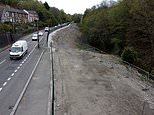
Woodside Terrace on Hafodyrynys Road has vanished and now all that remains of the once-bustling strip of family homes is an empty muddy bank next to a wooded mountainside.
The decision was made to knock down Woodside Terrace in Crumlin after nitrogen dioxide levels recorded in 2015 and 2016 breached world health rules.
The levels were recorded as the highest in the UK outside central London – and were caused by passing lorries and cars climbing the hill.
Those living on the street were paid to leave by the Welsh Government when their houses were bought above market prices in a £6m deal.
Use the slider tool to move from before and after the demolition. The decision was made to knock down Woodside Terrace in Crumlin after nitrogen dioxide levels recorded in 2015 and 2016 breached world health rules
Now: Woodside Terrace on Hafodyrynys Road has vanished and now all that remains of the once-bustling strip of family homes is an empty muddy bank next to a wooded mountainside. Pictured: Homes that are above the smog look down at the bank where the homes once stood
Before: Britain’s most polluted street outside London, seen here before demolition, has been completely demolished – because it was too dangerous to leave families living there
The row of 23 terraced homes has been flattened after residents were paid to leave because of the toxic fumes caused by 21,000 vehicles queuing to get up a steep hill in South Wales. Pictured: The remains of the homes now – a muddy bank on the right
All gone: Some of the other homes nearby have not been destroyed as they were able to pass air quality tests – because they are raised a couple of metres from the ground, according to Wales Online
Map shows Woodside Terrace is located just outside of Crumlin in South Wales and is on the road to Pontypool
Homes being torn down: Those living on the street were paid to leave by the Welsh Government when their houses were bought above market prices in a £6m deal
The street was known as ‘the most polluted in Wales’ and residents said thick black dust covered the walls and windows of the some of the houses, many feeling like prisoners in their own homes, according to WalesOnline.
Neighbours now say it is emotional to pass by the empty land and see no trace of the former homes.
One woman said: ‘It’s sad driving past and seeing the houses gone.’
Another said: ‘I keep thinking of all the previous residents who had wonderful memories living there I’m sure.’
One man said: ‘I understand it being the most polluted street but it was still peoples homes. Not just a house.’
In June 2021 it was revealed that tougher air pollution laws would be brought in following the death of a girl from an asthma attack caused by traffic fumes.
A Southwark coroner ruled in December 2020 that air pollution – including illegal levels of nitrogen dioxide – contributed to the 2013 death of Ella Adoo-Kissi-Debrah, who lived 80ft from the South Circular road in Lewisham, south-east London.
The nine-year-old died after suffering three years of seizures and nearly 30 visits to hospital for treatment to breathing problems.
The council admitted pollution levels were a ‘public health emergency’ at the time of the schoolgirl’s death but it failed to act on it.
The WHO guidelines suggest keeping an average concentration of PM2.5 under 10 micrograms per cubic metre of air (µg/m3), to prevent increased deaths.
The UK limit, based on European Union (EU) recommendations, is a yearly average of 25 µg/m3.
The levels were recorded as the highest in the UK outside central London – and were caused by passing lorries and cars climbing the hill. Neighbours now say it is emotional to pass by the empty land and see no trace of the former homes. Pictured: After and before
The street was known as ‘the most polluted in Wales’ and residents said thick black dust covered the walls and windows of the some of the houses, many feeling like prisoners in their own homes
Air pollution increases the risk of several conditions, including heart attack, stroke and diabetes
Emotional families returned to the street to watch the work begin to tear down their homes in October last year
Emotional families returned to the street in Wales to watch the work begin to tear down their homes in October last year.
Martin Brown, 74, lived in the row for 50 years with his beloved wife Pat before he was finally moved out.
He said: ‘I don’t know how it has affected my health, but it’s worrying.
‘There are families who lived here, one in particular, a woman, told me her two children were having breathing problems. Is it linked? We don’t know.
‘I’ve got problems now with my eyes and I wonder if it is as a result of all of this.’
Bob Stebbings, 77, retuned to the street to watch the work begin after growing up there as a child.
He said: ‘I lived here for 23 years and it was my childhood home where I had the best childhood you could imagine.
‘When I heard they were coming down I wanted to come, for some closure really.
‘I’m very sad, it feels upsetting and I will feel sad not to see the house there anymore.
‘But I know it needs to happen.
‘It always was a smoke trap this place. When I lived here it was all coal fires and in the morning, when everyone lit their fires, you could see the air was blue. It held in here.’
Caerphilly County Borough Council had to postpone some of the work due to the pandemic.
Council leader Philippa Marsden said in October: ‘The council, along with the whole community, welcomes the start of these demolition works, which will finally address the long-standing air quality problems at this site.
‘We explored a number of options, but demolition of these properties will allow us to achieve air quality compliance in the shortest possible time frame.’
Traffic surveys revealed that up to 21,000 vehicles used the road every day
A canyon effect is created as the hills and road towards Torfaen and Monmouthshire making it difficult for the polluting particles to disperse
Bob Stebbings, 77, who retuned to the street to watch the work begin after growing up there as a child
A canyon effect is created as the hills and road towards Torfaen and Monmouthshire making it difficult for the polluting particles to disperse.
Traffic surveys revealed that up to 21,000 vehicles used the road every day.
Some of the other homes nearby have not been destroyed as they were able to pass air quality tests – because they are raised a couple of metres from the ground, according to Wales Online.
Ms Marsden added: ‘It’s important that now we can open up the landscape here to allow the air to disperse which was obviously the problem we were facing.
‘The canyon effect meant that polluted air was hanging in the atmosphere and that was impacting residents so it was vitally important that we got this work under way.