

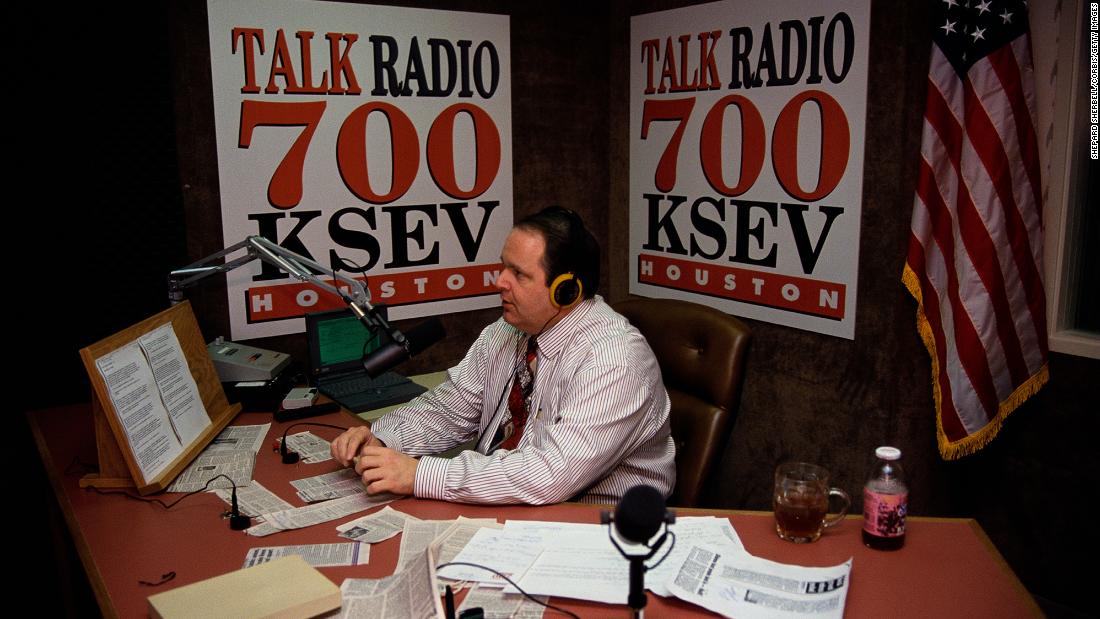
Opinion: Rush Limbaugh opened the airwaves to extremist commentary and built an empire
Coughlin, a Roman Catholic priest, was a widely controversial figure who amassed a huge audience in the 1930’s by mixing his post-Depression-era radio broadcasts about monetary reform with anti-Communist and anti-Semitic hate speech.
Limbaugh was a much more engaging broadcaster, wildly funny at times, a mimic, a deliberate buffoon — an entertainer, for sure. But he was also much luckier than Coughlin.
Limbaugh was able to build a talk-radio empire because, while the audience for a similar kind of bigoted, mean-spirited messaging may have been the same (or even larger) than it was in the 1930’s, tolerance for it in the media business was much greater.

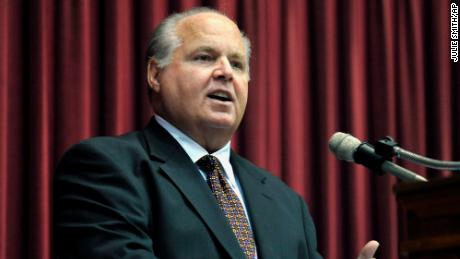
Shock tactics aside, Limbaugh was, unquestionably, a true pioneer. He opened up the talk-radio business to unabashed extreme commentary and it flourished, even as terrestrial radio struggled to survive. In cities all over America, local radio stations found voices that echoed Limbaugh’s far-right rants. And his approach made a lot of money for people all over the radio business.
Not as much as he made for himself, but still.
As happened in 2012, when a Georgetown University law student named Sandra Fluke testified in Congress, arguing that insurance companies should cover contraception. Limbaugh went after her with a bazooka.
Limbaugh wanted to know: “What does it say about the college co-ed [Sandra] Fluke, who goes before a congressional committee and essentially says she must be paid to have sex?” And went on to refer to her as a “slut” and a “prostitute.”

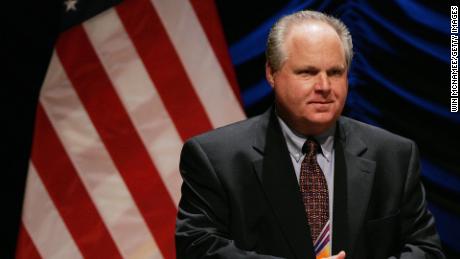
Clearly Limbaugh touched a nerve — lots and lots of them. And he moved millions. Partly that was because he was a really talented performer (especially early on, his show was consciously a performance more than a collection of political statements); but it was also because he did more than speak to his listeners. He validated them.
They came to him daily — in cars and on the beach or around the pools at retirement villages. They came to him for entertainment — and affirmation.
Millions of people wanted to know that views that were being disparaged elsewhere as hate-filled or hidebound — like thinking that “the NFL all too often looks like a game between the Bloods and the Crips without any weapons”— were absolutely valid. He made it all fun to kick around on the radio for three hours a day.
But he also created an industry. A vast one. Because he long preceded Donald Trump, he is arguably the figure most responsible for the conservative brand as it exists today.
There is a straight line from conservative talk radio to Fox News, Newsmax, One America News — and a more curved, twisted line to groups that supported Trump so emphatically. Dittoheads, as Limbaugh’s audience merrily called themselves, and followers of conservative radio voices all over the country, could easily be seen as forerunners of the Tea Party, MAGA and QAnon.
They loved Rush because he liked the people they liked, and he didn’t like the people they didn’t like. And they got so many great laughs when he made fun of the latter.