

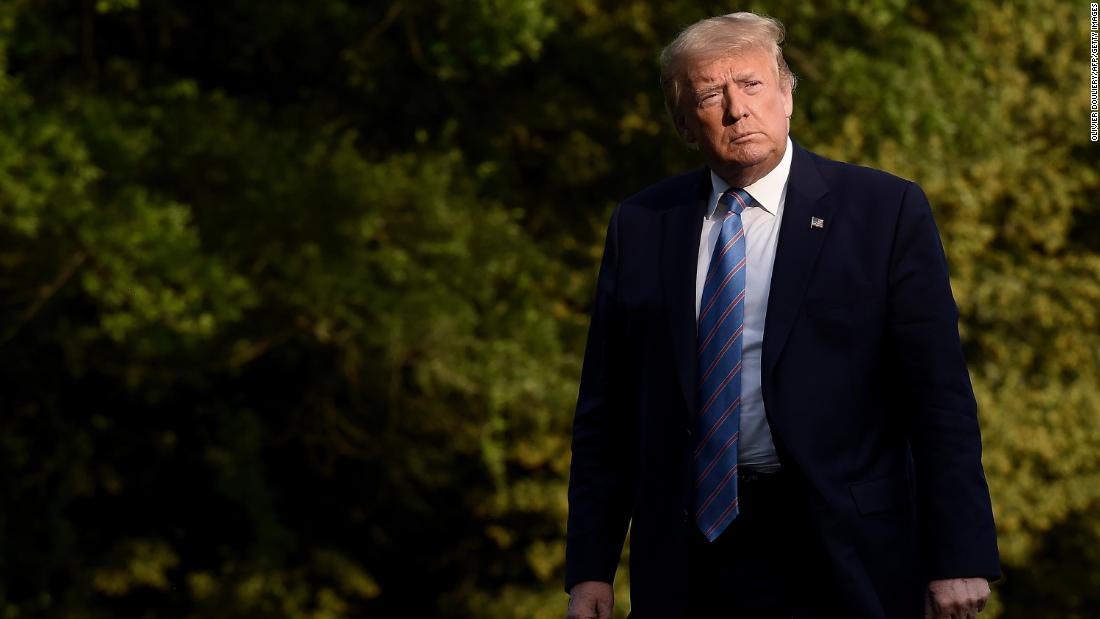
Analysis: Trump could sink the House GOP in suburbia
Now, recent national and district-level polls signal that many of the well-educated voters souring on Trump are also displaying more resistance to Republican congressional candidates than in 2018 — potentially much more.
That movement could frustrate GOP hopes of dislodging many of the first-term House Democrats who captured previously Republican suburban seats in 2018. It also means Democrats see further opportunities in white-collar House districts — from Pennsylvania and Georgia to Indiana and especially Texas — where the GOP held off the 2018 suburban tide, often only by narrow margins.
“The suburban exodus has continued, and my gut is as long as Trump is identified as the leader of the party, that continues,” says former Republican Rep. Tom Davis of Virginia, who served as chair of the National Republican Congressional Committee.
Even if Trump’s strength outside the metro areas allows the GOP to recapture some of the non-urban seats Democrats won last time, Davis warns, further suburban losses could still leave the party in a deeper hole after November.
“You can’t afford that,” says Davis, now a partner in Holland & Knight, a DC law firm. “[Suburbia] was the base of the Republican Party just a decade and a half ago. And there just aren’t enough rural voters to make up for those kind of losses. It means for the Republicans that instead of picking up seats in the House, that the bleeding could continue.”
The NRCC and some GOP consultants say such predictions overstate the party’s risk. They argue that the 2018 Democratic incursions into previously red-leaning suburban districts represented a high-water mark, driven by a greater turnout of Democratic voters than Republican ones during the midterm election. In the larger turnout of the presidential year, they maintain, many of these districts will snap back to their historic Republican leanings and allow both Trump and GOP House candidates to carry them again.

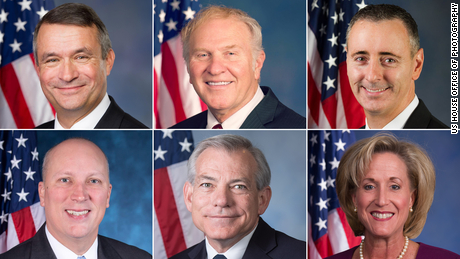
Top, from left to right: Republican Reps. Don Bacon, Steve Chabot and Brian Fitzpatrick. Bottom, from left to right: GOP Reps. Chip Roy, David Schweikert and Ann Wagner. All of them hold seats in districts Democrats have targeted that include more college graduates than the national average.
Bob Salera, a spokesperson for the NRCC, says the committee’s baseline assumption for these races is that Trump will run as well in most white-collar districts this year as he did in 2016, when he carried almost all of the new suburban districts Democrats are targeting in November, as well as many of those that the party captured in the 2018 midterms.
“For the most part, what we are seeing is Trump’s standing in these [suburban] districts is fairly close, within a couple points of where it was in the 2016 election,” Salera says. “Trump’s approval right now isn’t much lower, and in some cases in different places is higher, than it was in the 2016 election. Basically, we are looking at those 2016 numbers as a baseline for how the presidential [race] will play out in these districts.”
But Democrats, and even some Republicans, say that polling this spring flatly refutes the assertion that Trump’s position in white-collar House districts has not deteriorated since 2016.
In these suburban districts, “he’s underperforming,” says Robby Mook, president of the House Majority PAC, a Democratic super PAC. “The House battleground that we are looking at today [is districts] he won in 2016 and he is losing today. That’s just a fact.”

“There was this seismic shift in American politics in 2016 that advanced in 2018 and is continuing to advance now,” Mook says.
In recent weeks, the Democratic Congressional Campaign Committee and other party groups have publicly released or privately circulated polls that show Trump losing to presumptive Democratic nominee Joe Biden, often by substantial margins, in a wide array of well-educated districts, including many that Trump carried in 2016. The NRCC has discounted these polls as wishful thinking but has released very few of its own surveys this year, and none in the districts Democrats have spotlighted.
What the polls find
By comparison, even during the 2018 Democratic sweep, exit polls found that 38% of college-educated White voters approved of Trump’s job performance, according to results provided by Edison Research, which conducts the exit polls for a consortium of news organizations that includes CNN.
That decline contrasted with Trump’s showing among minorities in the new CNN and Monmouth polls, which found the President’s approval rating with voters of color was almost exactly the same as in the 2018 exit poll, just over 1-in-4 in each case.

But now Republicans hold only 23% of such seats, according to a new analysis of results from the Census Bureau’s American Community Survey conducted by CNN senior visual editor Janie Boschma. In all, Democrats control 135 of the House districts with higher-than-average college education levels, while Republicans hold just 41. (Those numbers reflect the new district lines drawn under court order in Pennsylvania, but not the new lines that state courts have approved in North Carolina.)
Many of the top Democratic House targets for November are within those remaining 41 Republican districts with more college graduates than average, including incumbent Reps. Brian Fitzpatrick in Pennsylvania, Ann Wagner in Missouri, Chip Roy in Austin, Don Bacon in Nebraska, David Schweikert in Arizona and Steve Chabot in Ohio, as well as opportunities in open seats around Indianapolis, Atlanta, Houston, Dallas and Raleigh, North Carolina. Several more potentially vulnerable GOP seats (including those held by incumbent Reps. Rodney Davis in Illinois, John Katko in New York and Scott Perry in Pennsylvania) come in just below the average education line.
The flip side is also true: Many of the Democrats elected in 2018 who Republicans most hope to oust hold seats in districts with many more college graduates than average, including Reps. Lizzie Fletcher and Colin Allred in Texas, Sharice Davids in Kansas, Elissa Slotkin and Haley Stevens in Michigan, Lucy McBath in Georgia, Abigail Spanberger in Virginia, Tom Malinowski in New Jersey and all the newly elected Democrats from Orange County, California.

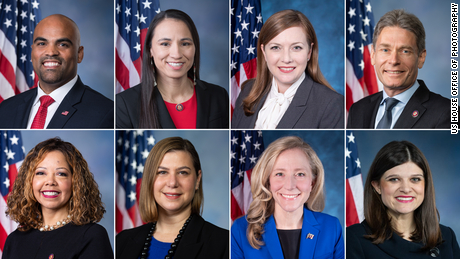
Top, from left to right: Democratic Reps. Colin Allred, Sharice Davids, Lizzie Fletcher and Tom Malinowski. Bottom, from left to right: Democratic Reps. Lucy McBath, Elissa Slotkin, Abigail Spanberger and Haley Stevens. All were elected in 2018 in House districts that have many more college graduates than the national average.
In 2016, when exit polls showed Trump running more competitively among college-educated White voters, he won many of the white-collar districts on both lists. With far fewer voters than in earlier generations splitting their tickets between presidential and House candidates, the outcome in many of them may be tipped by whether he does so again.
“In Texas, the Democrats performed about as well in the suburbs in 2018 as they’ve done in 20 or 25 years,” says Matt Mackowiak, a Republican consultant and GOP chair in Travis County (Austin).
Democrats see opportunities
After that the Democrats’ top targets are all districts that combine substantial racial diversity with large numbers of college graduates, including open seats in the suburbs of Dallas and Houston and challenges to GOP incumbent Reps. Chip Roy and, somewhat more distantly, Michael McCaul in districts that sprawl south from Austin through more conservative rural communities.
All of those seats have followed the white-collar movement toward the Democrats evident in other areas of the country since 2016. Except for the seat Hurd is vacating, Trump won the rest of those districts last time. But he did not exceed 52% of the vote in any of them, in each case carrying far less of the vote that Mitt Romney had done there in 2012.
Sri Preston Kulkarni, the Democratic nominee for the open seat in Fort Bend County, outside of Houston, was also the party’s candidate in 2018. A former foreign service officer who did not launch his campaign until January 2018, Kulkarni lost that year by 5 percentage points to Republican Pete Olson, who retired rather than seek reelection again after that close call.

Kulkarni says the climate for Democrats in the district is more favorable now and that Trump is “absolutely” weaker than he was there even two years ago. Under Trump, Kulkarni says, Republicans “are not looking for a broad coalition, they are focusing on a very small but intense coalition and they are leaving out the suburbs.” Nearly 46% of the district’s residents hold at least a four-year college degree and racial minorities compose a majority of its population, with immigrants representing nearly 1-in-4 residents, census figures show.
Kulkarni has been unflinching in criticizing Trump on both fronts; he told me he considers the President’s response to the Floyd protests a “threat to American values” and Trump’s handling of the coronavirus outbreak “the biggest failure of leadership in the government” he has ever seen.
Trump’s increasingly polarizing strategy for reelection helps explain why many strategists in both parties believe it will be difficult for as many House candidates as in the past to win in districts that vote for the other party in the presidential contest. That may help Republican challengers against Democratic incumbents in blue-collar and rural districts where Trump has been stronger, such as Reps. Collin Peterson in Minnesota, Jared Golden in Maine and Abby Finkenauer in Iowa. But it looms as a huge challenge for the GOP in these suburban areas.
Carlos Curbelo, a former GOP representative who lost his urban Miami district during the 2018 Democratic sweep, agrees it will be tough for the party’s candidates to escape the undertow if Trump doesn’t improve his position in those places.
“It’s almost impossible,” he says. “All candidates [are] encouraged to run their own races and maneuver however it is they need to in order to win. But with this heavy overlay, it’s very difficult. The space in which to maneuver is very tight.”
Like the NRCC’s Salera, GOP consultant Mackowiak says he believes Trump will perform better in these suburban districts than the party did in 2018. While Mackowiak believes that “if it’s a referendum on Trump he’s going to get killed in the suburbs,” he maintains the President can win back previously red-leaning college-educated voters by tying Biden and Democratic House candidates to liberal ideas such as the Green New Deal and single-payer health care that might advance under unified Democratic control of government.

Still, Mackowiak acknowledges that if 2020 produces an electoral divide in Texas similar to the one in the 2018 Senate race — with Trump holding the state by maximizing rural turnout while suffering huge losses in the big metro areas — it will “be a category five political hurricane” for local Republicans.
“The state House will be gone,” he said. “We will lose three or four congressional seats. That’s an unthinkable scenario.”
Yet many observers in both parties believe that’s exactly what the November election may produce in virtually every state: a widening trench between the preponderantly White small-town and rural areas that remain bonded to Trump and a deepening recoil from him in the diverse and well-educated urban and suburban population centers.
Trump may be comfortable with that trade since he is trying only to finesse one more Electoral College victory even if he loses the popular vote again. But many Republicans say Trump’s vision of squeezing bigger margins out of shrinking places at the cost of generating more resistance in communities that are growing is a losing long-term trajectory for the party. Nowhere is that more true than in the battle for control of the US House.
“It’s a strategy that is divorced from the reality of the country,” says Curbelo. “And there are Republican leaders in both chambers who are aware of this. This is not an important [consideration in] the President’s strategy because in his team’s mind they only have to win one more election. But for everyone else it’s a longer-term game. A lot of Republicans have been willing to be shortsighted and taken what they can get from the Trump era. But ultimately they know this is not the future of the party.”