

While the vast majority of cities closed their schools during the pandemic killed an estimated 5 million people worldwide, three opted to keep them open
During the influenza pandemic in 1918, even though the world was a very different place, the discussion was just as heated.
That pandemic killed an estimated 5 million people worldwide, including 675,000 Americans, before it was all over.
While the vast majority of cities closed their schools, three opted to keep them open — New York, Chicago and New Haven, according to historians.
The decisions of health officials in those cities was based largely on the hypothesis of public health officials that students were safer and better off at school. It was, after all, the height of the Progressive Era, with its emphasis on hygiene in schools and more nurses for each student than is thinkable now.

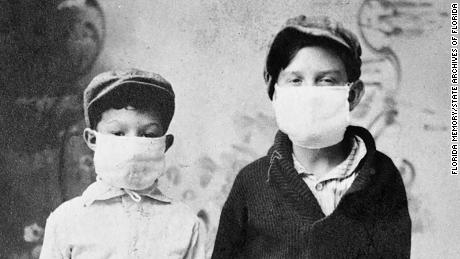
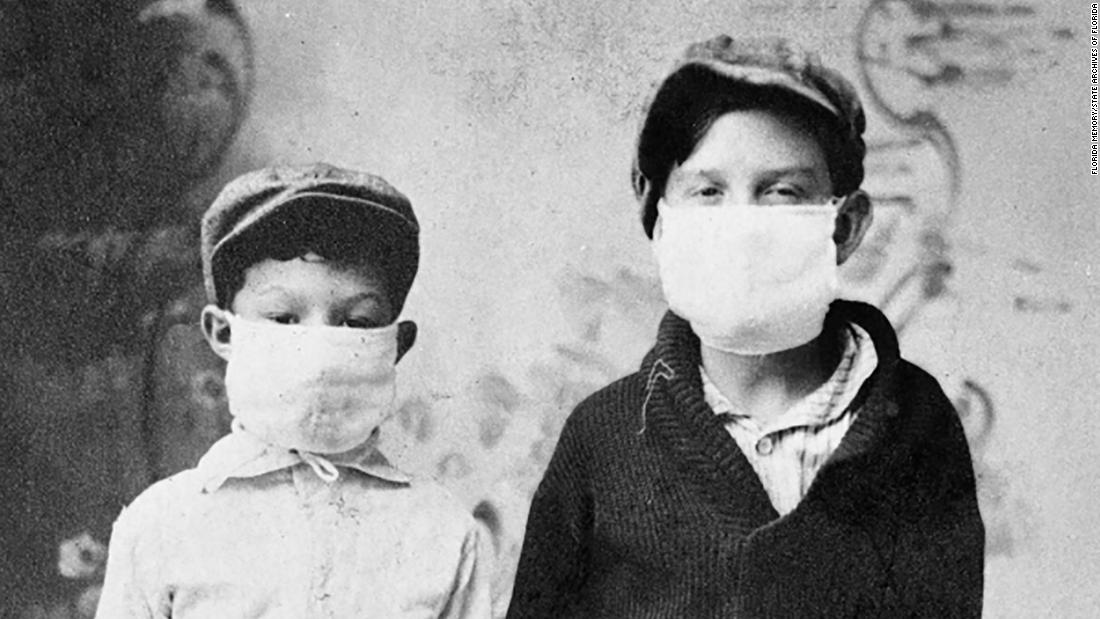
Don Hoover and Joe Sistrunk of Starke, Florida, are ready for school during the 1918 flu outbreak.
“For students from the tenement districts, school offered a clean, well-ventilated environment where teachers, nurses, and doctors already practiced — and documented — thorough, routine medical inspections,” according to the Public Health Reports article.
The city was one of the hardest and earliest hit by the flu, said Dr. Howard Markel, a medical historian and director of the Center for the History of Medicine at the University of Michigan. He was a co-author of the 2010 Public Health Reports article.
Students weren’t allowed to gather outside school and had to report to their teacher immediately, according to Copeland. Teachers checked students for any signs of the flu, and students who had symptoms were isolated.
If students had a fever, someone from the health department would take them home, and the health official would judge whether the conditions were suitable for “isolation and care,” according to Public Health Reports. If not, they were sent to a hospital.
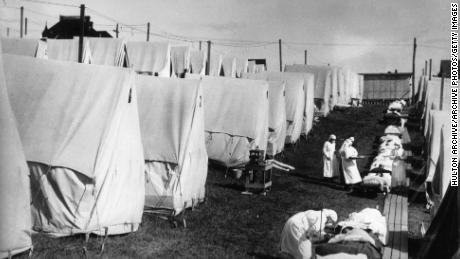
Influenza patients in Lawrence, Massachusetts, in 1918.
“The health department required families of the children recovering at home to either have a family physician or use the services of a public health doctor at no charge,” the Public Health Report article said.
The argument in Chicago for leaving schools open for its 500,000 students was the same: keeping schools open would keep the children off the streets and away from infected adults, the reasoning went.
If social distancing was helpful then, it would have been made easier by the fact that absenteeism in schools soared during the pandemic, perhaps because of what one Chicago public health official called “fluphobia” among parents.
“The absentee rate was so great, it really didn’t matter” that schools were open, Markel said.
The paper concluded that an analysis of data showed that “the decision of keeping the schools of this city open during the recent influenza epidemic was justified.”

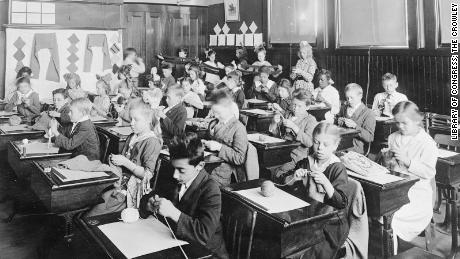
A fifth-grade class knitting for a Junior Red Cross project in Plainfield, New Jersey, in 1917 or 1918.
And in New York, then Health Commissioner Copeland told the New York Times: “How much better it has been to have the children under the constant observation of qualified persons than to close the schools.”
New York “didn’t do the worst, but it didn’t do the best, either,” Markel said, adding Chicago was slightly better.
Research showed that cities who implemented quarantining and isolation, school closures and bans on public gatherings fared the best, he said.
“The cities that did more than one” of these measures “did better. School closures were part of that contribution,” Markel said.
Public health experts, including Markel, are quick to point out that Covid-19 is not influenza, which was a well-known disease in 1918. There is still a lot to learn about the novel coronavirus and the disease it causes, Covid-19.
The right decision today, Markel said, is school closure.
“It’s better,” he said, “to be safe than sorry.”