

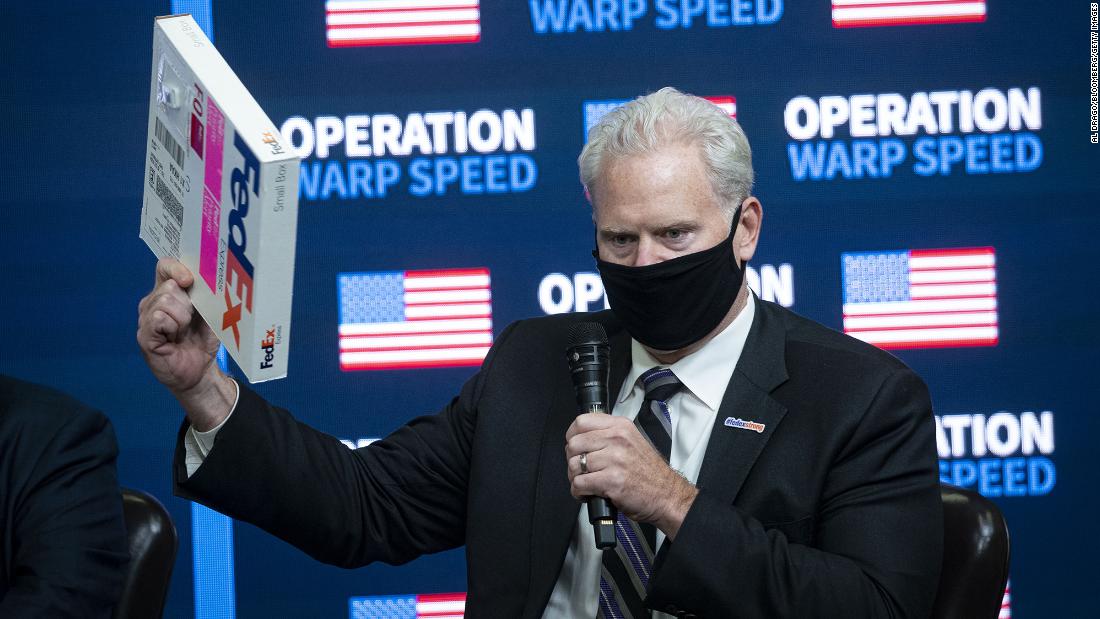
The global effort to move Covid-19 vaccines has begun
What’s happening: The US Food and Drug Administration has authorized the vaccine for emergency use. The United Kingdom and Canada have given the green light to begin distribution.
Businesses have been preparing for this moment for months. Thermo King — which revolutionized the transportation of food through advances in temperature-controlled shipping before World War II — has been working with pharmaceutical companies, governments and logistics firms to ensure vaccines stay frozen as they travel to clinics and hospitals.
To make this happen, they’ve reworked containers typically used to transport fresh tuna to Japan, which requires similar frigid conditions.
“We took that product and we amended it,” Francesco Incalza, president Thermo King Europe, Middle East and Africa, told me.
Tuna must be stored at -60 degrees Celsius, or -76 degrees Fahrenheit, to maintain its quality and deep red hue when it reaches supermarkets and restaurants, Incalza said. The Pfizer-BioNTech vaccine has to be stored at -70 degrees Celsius, or -94 degrees Fahrenheit, while in transit.
It’s just one example of how companies stand at the ready to handle the delicate, complex process of vaccine distribution.
Airlines will be at the center of the effort. Delivering vaccines will require an estimated 8,000 flights, according to the International Air Transport Association.
“Everybody needs this vaccine,” said Gates, the co-chair of the Bill and Melinda Gates Foundation. “If we only get it to the high-income countries, this disease is going to bounce around. We’re going to see twice as many deaths.”
The British pound could be heading for a crash
Currency traders who once assumed a deal would be completed before a Brexit transition period ends on Jan. 1 have been nervously watching the latest signals out of London and Brussels.
UK Prime Minister Boris Johnson traveled to Brussels last week for dinner with European Commission President Ursula von der Leyen. The trip failed to produce a breakthrough on thorny issues including fishing rights, government aid for companies and how disputes would be settled.
Investors are likely to see the extension as a positive sign. But they won’t be able to fully relax until a deal has been finalized.
“The binary outcome [deal or no-deal] is on a knife’s edge which potentially sets the pound up for an outsized move once the Brexit saga reaches its finale,” Han Tan, a market analyst at FXTM, said in a research note Friday. The fact that the pound hasn’t yet “capitulated” against the dollar suggests there’s still “pent-up hope” that a deal will be secured, he added.
The pound was trading close to $1.35 earlier this month when an agreement between the United Kingdom and its biggest export market looked more likely. Analysts have warned that the currency could quickly plunge to $1.20 if it becomes clear that a deal is no longer possible. On Friday, it hovered near $1.32, a 0.6% decline.
Up next
Monday: OPEC monthly report
Wednesday: Federal Reserve decision; US retail sales; Flash PMI data