

Analysis: Why the GOP and corporate America are breaking up
Corporate America’s years-long move toward a political awakening has increasingly put large companies in direct opposition to the GOP, a political party that spent generations crusading as the friend of business and slasher of corporate taxes.
“Our private sector must stop taking cues from the Outrage-Industrial Complex,” Senate Minority Leader Mitch McConnell said Monday in a written statement, in which he also accused companies and Democrats of “disinformation.”
“Americans do not need or want big business to amplify disinformation or react to every manufactured controversy with frantic left-wing signaling,” he said.
The Trump years accelerated the desire of large companies to at least appear responsive to civil rights.
Companies severed ties with the soon-to-be President over his comments about immigrants just as his campaign was gaining steam, a move that seems strange in hindsight since his major legislative accomplishment was a permanent cut in corporate tax rates.
Whether large companies see the tax hikes or the government spending as a bigger boon will have to wait.
What the bottom line says
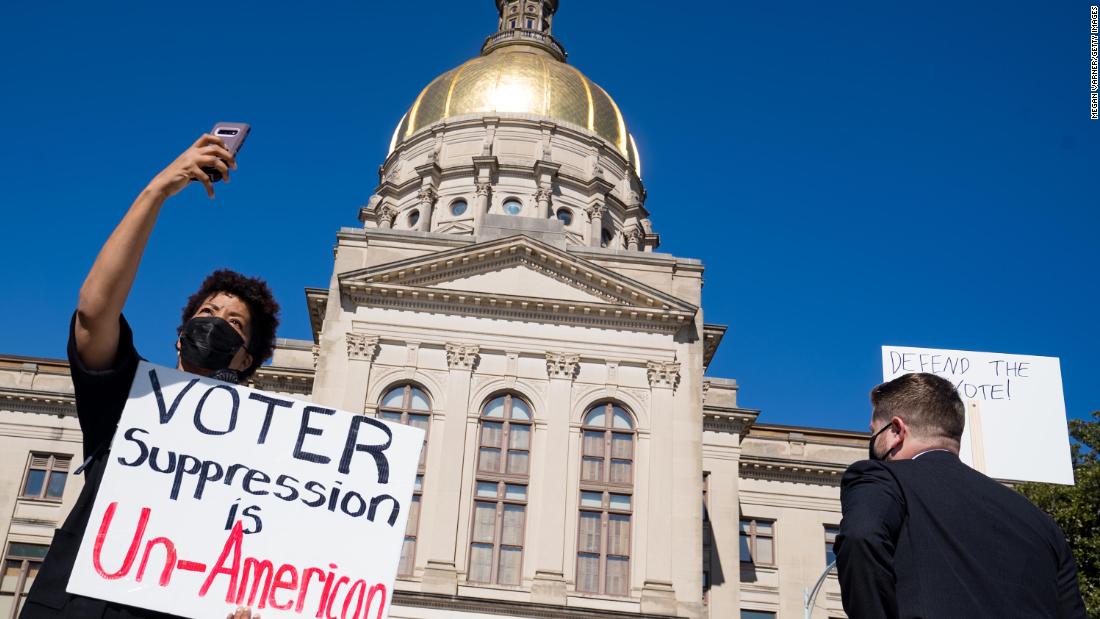
Right now, big business is most vocal in its disapproval of the GOP’s naked effort to cut down on Democratic votes and reclaim the House and Senate in 2022.
Let’s not assume that public companies, generally, do things because they’re the right thing to do, but rather acknowledge they are legally required to be motivated by the bottom line.
Republicans, meanwhile, are pointing out the hypocrisy of companies like Delta and Coca-Cola calling out the Georgia voting rights law, while also, as multi-national corporations do, pursuing business in China.
As Sen. Marco Rubio, the Florida Republican, said in a tweet:
Dear @Delta:
You are business partners with the Communist Party of #China
When can we expect your letter saying that their ongoing genocide in #Xinjiang is “unacceptable and does not match Delta’s values”???
#WokeCorporateHypocrites
The Wall Street Journal wondered if Biden’s endorsement of sports boycotts related to justice will extend from the Georgia law to the upcoming Winter Olympics scheduled to take place in 2022.
Looking beyond Georgia
The activists pushing for changes in places like Georgia aren’t exactly satisfied with the corporate nods, which will have a debatable effect in Georgia, where the law has already been put in effect and now faces a court battle.
Republicans in other states, however, have their own plans to make voting more difficult. The Georgia example could certainly have an impact in those places.
How the culture wars have changed
Another thing to consider is the evolution of culture wars in the US.
While few companies will want to take a stand on a issue like abortion, that is complicated by personal and religious beliefs, it’s much easier for companies to take stands on something as simple as voting rights. Of course the government should be making it easier for people to vote.
Other companies might be looking for some image rehab of their own. Facebook, Twitter and Google, targets of Democratic frustration about access to misinformation on their sites and Republican allegations they minimize conservative views, have all criticized the Georgia law and some have endorsed Democrats’ proposal to create more national voting standards.
The journey to corporate wokeness has been a long time in the making.
A boycott of Arizona for an law widely perceived as anti-immigrant may have cost the state more than $100 million, but it largely fizzled after courts defanged the state law.
Nike is enough invested in the perception of social justice that it sponsors a quarterback, Colin Kaepernick, who says he’s been blackballed by the league.