

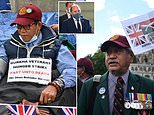
Gurkhas END hunger strike after 13 days as Government agrees to enter talks over equal pensions
Gurkhas END hunger strike after 13 days as Government finally agrees to enter talks over equal pensions
Former British Gurkha servicemen have brought their 13-day hunger strike outside Downing Street to an end Ben Wallace finally agreed to enter talks with the Nepalese Embassy over equal pensions for veterans The strikers were part of a group of protesters calling for equal pensions for Gurkhas who retired before 1997 Around 200,000 fought in both world wars, also serving in places such as the Falklands, Iraq and Afghanistan
Former Gurkha soldiers who fought for Britain have brought their 13-day hunger strike outside Downing Street to an end after Defence Secretary Ben Wallace finally agreed to enter talks with the Nepalese Embassy over equal pensions for veterans.
The hunger strikers were part of a group of 150 protesters calling for equal pensions for Gurkhas who retired before 1997 and are not eligible for a full UK armed forces pension.
They had not eaten for almost a fortnight, with a spokesman for the group saying Dhan Gurung, a diabetic 60-year-old veteran, was admitted to hospital with heart problems early on Wednesday and had less than a week before his condition became really serious.
But this afternoon, the Ministry of Defence announced it would open talks with the Nepalese Embassy about the matter. A spokeswoman for Mr Wallace said: ‘We are happy the Satyagraha (non-violent resistance) group have agreed to break their fast.
‘Our primary concern is always the health and welfare of our serving personnel and veterans and this strike was not a course of action we encouraged. We look forward to meeting with the group next month alongside the Nepali Ambassador to move forward together.’
Around 200,000 fought in both world wars, also serving in places such as Hong Kong, Malaysia, Borneo, Cyprus, the Falklands, Kosovo, Iraq and Afghanistan. Those who served from 1948 to 2007 were members of the Gurkha Pension Scheme until the differences between Gurkhas’ terms and conditions of service and those of their British counterparts were removed.
The Gurkha Pension Scheme was based on Indian Army rates for those with at least 15 years’ service. The Government says that it was designed for retirement in Nepal, where the cost of living is significantly lower than in the UK.
In 2007, pension rules were changed to give serving Gurkha soldiers equal pension rights. But the British Gurkha Welfare Society said 25,000 men who had retired before July 1, 1997 were denied the opportunity to transfer into UK armed forces pension schemes.
Dhan Gurung has his blood pressure checked by a medic as he continues a hunger strike during a demonstration for equal pensions outside Downing Street on August 18, 2021
Former British Gurkha soldiers and their families protest outside parliament in London
Dhan Gurung on day 12 of a hunger strike opposite Downing Street in London
Defence Secretary Ben Wallace arrives at the Prime Minister’s official residence
The Royal Gurkha Rifles perform a Khukuri fighting demonstration at their base in Folkestone, Kent in 2007
Around 200,000 fought in both world wars. Pictured: British colonial Gurkhas in France during the First World War
The Gurkha men, recruited from Nepal, have a reputation as hard and loyal fighters, and are known for the trademark curved kukri blades they carry sheathed on their belts.
The Gurkha Equal Rights campaign group tweeted on Thursday afternoon: ‘BREAKING NEWS ! Government has a struck a deal with the Nepal Embassy for a government to government dialogue.
’13 days of fast unto death, the hunger strike has now been called off ! Thank you everyone for your support and love!’
Speaking previously about the protest, Mr Gurung – was taken to hospital with heart problems shortly after 1.30am on Wednesday before being discharged – said: ‘We will keep coming back here, we want to continue our hunger (strike) until death. We don’t care about sacrificing our life.’
Laxmi Ghising, speaking on behalf of the group, said Mr Gurung – who has problems with diabetes – was taken to hospital yesterday after his body turned cold and his blood pressure became too high.
Mr Ghising said: ‘He’s comfortable now, if he had refused to go to hospital there would have been very bad consequences- he might have collapsed.
‘Fortunately he agreed to go to hospital for the treatment and once he came back he’s now okay, but he’s not comfortable to talk.’
He went on to say that Mr Gurung continues to feel cold and tired, while his tongue has become inflamed.
However, he said the veteran would remain in his wheelchair opposite Downing Street without eating until the Government agrees to address the Gurkhas’ issues.
Asked how long it will be before his health situation becomes serious, Mr Ghising added: ‘Maybe less than a week. All the general public, all our campaigners are panicking – we are really rushed.
‘Come on Government, come on, we just need your black and white letter saying the date and time for the dialogue meeting. Once we receive that letter we will immediately cease this hunger strike.’
An MoD spokesperson previously said: ‘We greatly value the huge contribution Gurkhas make to the British Army and ensure they are supported with a generous pension and medical care during retirement in Nepal.
‘We are committed to ensuring the Gurkha Pension Scheme is sustainable and fair alongside other UK public sector pensions.’
Boris Johnson was seen leaving Downing Street and heading to Parliament at around 9.20am on Wednesday. The Gurkha protesters, along with other protesters campaigning on separate issues, began shouting at the Prime Minister as he drove past.
Shortly after 11am, hundreds of Gurkhas marched past Parliament.
They were chanting ‘No justice, no peace’ and ‘What do we want? Justice’ as they walked past the House of Commons. The Gurkhas later looped back round and walked to Parliament Square.
Later on, the Gurkhas sat on the grass where they listened to speeches and applauded. They also watched a performance of a traditional masked dance.
Dhan Gurung receives a shoulder massage as he continues a hunger strike during a demonstration for equal pensions outside Downing Street on August 18, 2021
Pushpa Rana Ghale has a foot massage as she continues a hunger strike
Former British Gurkha soldiers and their families protest outside parliament in London
Support our Gurkhas protester Gyanraj Rai gestures as he continues a hunger strike during a demonstration for equal pensions
The Gurkhas were first recruited by Britain in 1815 to ensure that they did not fight for Nepal, with which the British East India Company was then at war.
A hasty peace deal had just been signed after the Company suffered heavy casualties during the invasion of Nepal. This allowed it to recruit from the ranks of the former enemy.
When the East India Company’s forces mutinied in 1857 the loyalty of the Gurkhas made them central to British rule. They policed India’s northern hills with their tactical skills and were expected to continue serving for India when the country secured its independence in 1947.
It made religious sense because Nepal was officially Hindu and would also have allowed Nepalis to easily return home on leave.
However, following the partition of India, an agreement between Nepal, India and Britain meant four Gurkha regiments from the Indian army were transferred to the British Army, eventually becoming the Gurkha Brigade.
The name ‘Gurkha’ comes from the hill town of Gorkha from which the Nepalese kingdom had expanded.
The brigade has always been dominated by four ethnic groups – the Gurungs and Magars from central Nepal, the Rais from the north-east and Limbus from the east. The latter live in villages of impoverished hill farmers.