

Europe’s Covid crisis: Austria makes vaccines mandatory for EVERYONE
Austria makes vaccines mandatory for EVERYONE and imposes full nationwide lockdown, as Europe’s cases hit a record high, Germany says 30million jabs are needed by Christmas and Ireland places its hospitals on a ‘war footing’
Austria has become the first Western country to make Covid vaccines mandatory amid brutal wave of virusFrom February 1 everyone will be need to be jabbed or else face unspecified ‘penalties’, chancellor has saidAlexander Schallenberg said that ‘for too long’ the government assumed herd immunity could be achieved voluntarily and that it is now time to ‘face up to reality’ by requiring people to protect themselvesAlso announced new lockdown to start Monday, with people only allowed to leave home for ‘essential’ reasonsEuropean leaders are rushing to impose new restrictions as it was revealed the continent’s one-day case toll topped the previous wave yesterday, with 310,000 infections logged compared to 290,000 this time last year
<!–
<!–
<!–<!–
<!–
(function (src, d, tag){
var s = d.createElement(tag), prev = d.getElementsByTagName(tag)[0];
s.src = src;
prev.parentNode.insertBefore(s, prev);
}(“https://www.dailymail.co.uk/static/gunther/1.17.0/async_bundle–.js”, document, “script”));
<!–
DM.loadCSS(“https://www.dailymail.co.uk/static/gunther/gunther-2159/video_bundle–.css”);
<!–
Austria has become the first Western nation to make Covid vaccines mandatory for everyone as the government scrapped its ‘vaccine apartheid’ rules in favour of a full nationwide lockdown today.
Chancellor Alexander Schallenberg announced that, from February 1, everyone will be legally required to have a Covid vaccine. He did not make it clear which age groups will be included, though it is assumed there will be exemptions for the very young and those who cannot be jabbed for medical reasons.
Health Minister Wolfgang Muckstein said the government has consulted with constitutional lawyers who believe the move is legal, but said there will be a ‘proper review period’ before the law comes into force. Mr Schallenberg added that violators will likely face fines rather than criminal penalties, but that details still need to be fleshed out.
Austria’s fully-jabbed rate currently stands at 66 per cent, just below the European average of 67 per cent and below the theoretical level of 70 per cent needed for herd immunity. It reported 15,000 new cases Thursday – another one-day record – and its infection rate stands at 990.7 per 100,000 over the last seven days, one of Europe’s highest.
It is not the first country to make vaccines mandatory. Indonesia required all adults to get jabbed back in February, followed by dictatorships Turkmenistan and Tajikistan in July. Dozens of other countries, including many western nations, require specific groups – such as healthcare workers – to have jabs.
Speaking today, Schallenberg said: ‘For a long time there was consensus in this country that we do not want vaccinations to be compulsory. For a long time, maybe too long, it was assumed that it would be possible to achieve a high vaccination rate even without an obligation. Now we have to face reality.
‘Whipped up by radical anti-vaxxers, by fake news, too many among us didn’t get vaccinated. The results are overcrowded intensive care units and enormous suffering,’ he added, accusing the un-jabbed of launching an ‘attack on the health system.’
The move is likely to prove hugely controversial, coming after Austria locked down only unvaccinated people in a move dubbed ‘health apartheid’. That was today scrapped in favour of a full lockdown, with everyone banned from leaving their homes except for ‘essential’ reasons starting Monday. It is due to last at least 20 days.
The shock announcement came as…
Europe’s Covid cases hit an all-time high, with 310,000 infections logged Wednesday – higher than the previous one-day record of 290,000 registered around this time last yearGerman health minister Jens Spahn said he ‘can’t rule out’ a full lockdown over the Christmas period, adding that the country is in a ‘state of emergency’ with cases rising rapidlyIncoming German Chancellor Olaf Scholz said 30million vaccines need to be given before the end of the year, meaning the country will have to more-than double its current jab rateIreland put its hospitals on a ‘war footing’ for the next fortnight, warning doctors they may have to make ‘unthinkable’ choices about who to treat if intensive care units overflowItaly said it will tighten its own Covid rules starting next week and it is ‘inevitable’ that the unvaccinated will be hit harder than the vaccinated
Austria is among the European nations worst-affected by the new wave of Covid, with infections soaring rapidly even as cases rise across most nations on the continent. Generally, those with the lowest vaccination rates are being hit hardest
Covid deaths are still far below rates seen during the first and second waves of the pandemic, thought to be in-part due to protection conferred by vaccines, though have started to climb rapidly in recent days
Austrian Chancellor Alexander Schallenberg (right) and Health Minister Wolfgang Mueckstein (left) announce that the country is going back into full lockdown and that, from next year, vaccines will be mandatory
From February 1, all Austrians will need to be vaccinated or face unspecified ‘penalties’. It is assumed the very young and those who cannot be jabbed for medical reasons will be exempt (file image, a vaccine centre in Austria)
Ireland, which imposed a night-time curfew on hospitality businesses this week, has today placed its hospitals on a ‘war footing’ with routine operations cancelled to make room for Covid patients amid a warning from the country’s top doctor that intensive care medics face ‘unthinkable’ choices over who to give care to.
And Germany’s incoming Chancellor Olaf Scholz said almost 30 million vaccines need to be administered before the end of the year to ward off the worst effects of the winter wave, which would require the country to more-than double the number of shots it currently gives each day.
He spoke a day after Germany put forward new rules that would restrict the movements of unvaccinated people in states where hospital admissions are high.
The new three-tier system would require people to show evidence of a vaccination or previous infection to enter public buildings or businesses in states where hospitalisation rates go above 3 in 100,000 people, based on a seven-day average. At present, that will affect 9 of Germany’s 16 states.
Once hospitalisation rates top 6 in 100,000, measures tighten again – with negative tests required in addition to vaccines or previous infections to enter high-risk businesses such as clubs and bars. At present, Bavaria would be the only state affected though Mecklenburg-Western Pomerania is a borderline case.
And once the rate goes above 9 in 100,000, regions would go into a more general lockdown with social distancing measures becoming mandatory along with other curbs similar to last winter. Saxony-Anhalt and Thuringia have already exceeded this threshold.
Country-wide measures will include evidence of vaccine, infection or a negative test to use public transport, with vaccines made mandatory for heath workers.
The measures were passed by the Bundestag on Thursday following a meeting between the federal government and regional leaders. The Bundesrat, the upper house of parliament, is due to vote on them today.
Meanwhile Italy became the latest country to target the unvaccinated for lockdown, with a government spokesman saying it is ‘inevitable’ they will face harsher restrictions when a new decree is published next week.
The statement came following a meeting between health minister Roberto Speranza and undersecretary of state Roberto Garofoli on Thursday, who agreed the countrys’ outbreak is worsening and action is needed to tackle it.
Regional Affairs Mariastella Gelmini declared that there ‘is no desire to divide the country’ but added ‘if the increase in infections and hospitalizations were to lead to new restrictions, it would not be conceivable to put the vaccinated and the unvaccinated on the same level.’
Europe’s third wave of Covid infections has now exceeded the peak of its second wave with 310,000 infections registered Wednesday, more than the 290,000 recorded at the same point last year
Deaths across the continent are also slightly below the same time last year, though are climbing rapidly amid fears that it could exceed the second wave as the virus seeks out the unvaccinated
Europe has become the epicentre of the pandemic once again, with the World Health Organisation warning that the Continent was the only region in the world where deaths had increased – with Covid-related fatalities spiking by five per cent just this week
From Monday, all Austrians will be confined to their homes except for ‘essential’ reasons with all non-essential shops and most schools closed. Until now, it was only the unvaccinated who had been shut inside (pictured, people in Vienna today)
Austria is battling a brutal third wave of Covid that has seen infections soar to record levels in recent days, far surpassing last winter’s infection totals and leading to fears that deaths will soon start mounting
Covid deaths in Austria are not yet at levels seen last winter but have begun to climb rapidly, amid fears that this winter’s death toll may be worse than the last because the country still has large numbers of unvaccinated people
The Czech Republic has already followed Austria’s lead by banning unjabbed people from access to public events, bars and restaurants from next week.
And Slovakia is also considering imposing a similar measure which would see unvaccinated people banned from non-essential stores, shopping malls, gyms, pools, hotels and mass public gatherings for at least three weeks after recording 8,342 daily cases.
Earlier this week, Belgium made facemasks compulsory and introduced working from home instructions.
Austria reported 15,145 cases on Thursday, a new one-day record for the pandemic and well above the previous record of 9,586 that was logged a year ago.
The hardest-hit region has been Upper Austria, where the governor today called for restrictions on the un-jabbed to be scrapped – but only so that a full nationwide lockdown can be imposed instead.
In Belgium, all people in indoor venues such as cafes and restaurants will need to wear a mask unless seated and the rule will apply to those aged 10 or older. The previous age threshold was 12.
Nightclubs may have to test their guests if they want to let them dance mask-free. People wanting to eat in a restaurant or go to the theatre already must present a COVID pass, showing vaccination, a negative test or recent recovery.
Most Belgians will also have to work from home four days a week until mid-December, and for three days after that.
Belgium has one of the highest cases per capita rates in the European Union, behind only the Baltic and former Yugoslav nations and Austria, at around one per hundred people over the past 14 days, according to the European Centre for Disease Prevention and Control.
‘The alarm signals are all red,’ prime minister Alexander De Croo told a news conference. ‘We had all hoped to have a winter without coronavirus, but Belgium is not an island.’
The new restrictions are still milder than the lockdown imposed on the unvaccinated in Austria and the shortening of bar and restaurant opening hours in the Netherlands.
De Croo said Belgium planned to give booster jabs, currently limited mostly to the elderly, to the wider population.
Belgium’s infections spike has been sharpest in the northern region Flanders, where vaccination rates are higher, prompting eased restrictions in October.
The warning comes as a hospital in Bavaria’s Freising last week made the unprecedented decision to transfer a Covid-19 patient to northern Italy because it ‘had no more capacity to receive them, and the surrounding hospitals were also full.’
A fourth ferocious wave has sent infections to record highs in Europe’s biggest economy, putting hospitals also hit by the double whammy of a shortfall of personnel under immense strain.
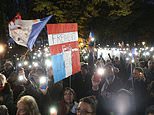
Protesters gather in front of the Austrian embassy in France overnight to protest the government’s lockdown of the unvaccinated, even before the chancellor announced that jabs will become mandatory
Flag-waving protesters gather outside the Austrian embassy in Paris overnight, demonstrating against the lockdown of unvaccinated people in the country
Florian Philippot, leader of French nationalist party ‘Les Patriotes’, and his supporters demonstrate in front of the Austrian embassy in Paris
European stocks retreated from record highs today, while government bond yields, oil prices and the euro tumbled as the spectre of a fresh COVID-linked lockdown in Germany and other parts of Europe cast a fresh shadow over the global economy.
As cases rises again across Europe, a number of governments have started to reimpose limits on activity, ranging from Austria’s full lockdown, to a partial lockdown in the Netherlands, to restrictions on the unvaccinated in parts of Germany, the Czech Republic and Slovakia.
Hungary reported 11,289 new COVID-19 cases on Friday, its highest daily tally, and will make booster shots mandatory for all healthcare workers and require mask wearing in most indoor places from Saturday.
While the new measures across Europe are not seen hitting the economy as much as the all-out lockdowns of last year, analysts say they could weigh on the recovery in the last quarter of the year, especially if they hit the retail and hospitality sectors.
A full lockdown in Germany would be more serious, however.
‘A total lockdown for Germany would be extremely bad news for the economic recovery,’ said Ludovic Colin, a senior portfolio manager at Swiss asset manager Vontobel.
‘It’s exactly what we saw in July, August of this year in parts of the world where the delta (variant) was big, it (COVID-19) came back and it slows down the recovery again,’ he added.
The pressure on intensive care units in Germany had not yet reached its peak, Spahn said, urging people to reduce contacts to help break the wave.
‘How Christmas will turn out, I dare not say. I can only say it’s up to us,’ he added.
Chancellor Angela Merkel said on Thursday Germany will limit large parts of public life in areas where hospitals are becoming dangerously full of COVID-19 patients to those who have either been vaccinated or have recovered from the illness.
Merkel said on Thursday the federal government would consider a request from regions for legislation allowing them to require that care and hospital workers be vaccinated.
Saxony, the region hardest hit by Germany’s fourth wave, is considering shutting theatres, concert halls and soccer stadiums, Bild newspaper reported. The eastern state has Germany’s lowest vaccination rate.
New daily infections have risen 14-fold in the past month in Saxony, a stronghold of the far-right Alternative for Germany (AfD) party, which harbours many vaccine sceptics and anti-lockdown protesters.
Much of the Austrian public is also sceptical about vaccines, a view encouraged by the far-right Freedom Party, the third-biggest in parliament. It is planning a protest against coronavirus restrictions on Saturday.
Anti-lockdown Sweden now has Western Europe’s LOWEST Covid infection rate despite wave rolling across the continent
Sweden now has the lowest Covid infection rate in western Europe — after double-vaccinated nationals were told they don’t have to test for the virus even if they get symptoms.
The Scandinavian nation — which was subject to international scrutiny last year when it refused to lockdown — is currently recording 85.4 cases per million people, according to Oxford University research site Our World in Data.
By comparison, the rate is nearly 1,400 per million in Europe’s current Covid capital Austria, which today announced it is going back into a full lockdown from Monday.
Sweden’s infection rate is far lower than other Western European countries like the Netherlands (1,048.7), Britain (581), Germany (536), and France (201).
And for the first time in the pandemic, Sweden is recording fewer cases per population size than its Scandinavian neighbours Denmark (655), Norway (351) and Finland (150).
The above graph shows the Covid infection rate per million people for western European countries from November last year. It reveals that Sweden currently has the lowest infection rate in the region
The above graph shows the proportion of the population that has received two doses of the Covid vaccine by nation. It reveals that Sweden is in the bottom half of countries for vaccine uptake, but ahead of nations including the UK and Germany
But critics say Sweden has been left ‘in the dark’ over the true extent of its coronavirus wave because the double-vaccinated, equivalent to almost seven in ten people, are not being routinely swabbed.
Last week, Sweden broke ranks with its European neighbours once again and told Swedes they did not have to get tested if they were fully jabbed, even if they had symptoms. Covid swabbing rates plunged 35 per cent last week, compared to a month earlier.
But this week the policy was reversed in response to rising cases on the continent. A fresh wave of Delta is rolling across the continent and putting pressure on hospitals once again, which has forced most in the EU to bring back some form of curbs.
Latest figures show Sweden is only carrying out 1.26 tests per 1,000 people, which is also the lowest number in western Europe.
Boris Johnson warned this week that Europe’s wave could spill onto Britain’s shores, but virologists say that the continent is behind the UK which saw a surge in cases over the summer.
Sweden paused free Covid tests for the vaccinated last week but will restart the scheme from November 22.
At the time, its health agency argued the resources for testing could be better used elsewhere and that there was no need to test the fully vaccinated because they have a low risk of getting sick and are less likely to spread the disease.
It is currently carrying out just 1.26 tests per 1,000 people, the lowest number in western Europe. For comparison, the UK is carrying out 12 times more swabs, Austria 47 times more, and France almost four times more.
Swedes have complained that Covid tests are inconvenient because — unlike in Britain — they require people to submit their bank ID and speak to clinicians who decide whether they should be swabbed.
The Scandinavian nation became an international outlier last year when it defied scientific advice and refused to follow the rest of the world in shutting down society to curb the virus’ spread.
Although Sweden chose not to lock down completely early in the pandemic, it did introduce stricter legally-binding curbs last winter as cases and deaths rose.
Sweden dropped its final Covid curbs on September 29, when it cancelled its recommendation to work from home.
Unlike other European countries it has never made face masks compulsory or enforced compulsory lockdowns.
But from December 1 the country is ramping up Covid restrictions to require everyone attending events of more than 100 people to confirm they are double-vaccinated.
Although Sweden chose not to lock down completely early in the pandemic, it did introduce stricter legally-binding curbs last winter as cases and deaths rose. A couple hug and laugh as they have lunch in a restaurant in Stockholm, Sweden
Anders Tegnell — Sweden’s chief epidemiologist and the architect of its no lockdown approach — has warned more restrictions may be needed to curb the spread of the virus.
He said yesterday: ‘If we have the continued low pressure from the virus which we have just now, then maybe proof of vaccination [for larger public gatherings] would be enough.
‘But experiences from many other European countries — the Netherlands, Belgium, Austria — suggest that if the spread of the virus increases, then this is not enough.’
Sweden is middle of the road when it comes to vaccine uptake in western Europe. Some 68.7 per cent of the entire population have had both doses of the virus.
This is slightly above the UK (67.5 per cent double-jabbed) but below other nations including Spain (80.2 per cent) and the Netherlands (73.5 per cent). In Austria vaccine uptake is 63.9 per cent.
Sweden is currently offering booster shots to all over-65s from six months after their second dose, and eventually plans to expand the roll out to all over-16s. It has also recently started offering jabs to 12 to 15-year-olds, although reports suggest uptake has been low.
For comparison, Britain is currently offering booster doses to all over-40s and first jabs to 12 to 15-year-olds. There have been suggestions this roll out could be expanded further.
Sweden has cut a different path to other European countries through out the pandemic, choosing to rely on citizens to make the right choices during the first wave instead of locking down.
Last winter it imposed more restrictions bringing more in line with the rest of Europe including limiting the number of people who could attend outdoor concerts, cinemas and markets, and curtailing opening hours for bars.