

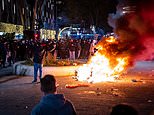
Police fire warning shots at protesters in Rotterdam as tensions boil over at new Covid restrictions
Netherlands police fire ‘warning shots’ at anti-lockdown rioters leaving several hurt amid rising anger at Euro Covid restriction as Austria makes vaccine MANDATORY and Germans face ‘Christmas lockdown’
Police also fired water canons as demonstrators lit first and set off fireworksThe riot took place Friday night in one of Rotterdam’s main shopping streetsComes a week after new Covid-19 measures came into force in The NetherlandsPolice confirmed warning shots had been fired, likely resulting in some injuries Austria on Friday became first European country to reimpose full lockdownNeighbouring Germany warned it may follow suit as cases rise across Europe
<!–
<!–
<!–<!–
<!–
(function (src, d, tag){
var s = d.createElement(tag), prev = d.getElementsByTagName(tag)[0];
s.src = src;
prev.parentNode.insertBefore(s, prev);
}(“https://www.dailymail.co.uk/static/gunther/1.17.0/async_bundle–.js”, document, “script”));
<!–
DM.loadCSS(“https://www.dailymail.co.uk/static/gunther/gunther-2159/video_bundle–.css”);
<!–
Dutch police fired warning shots on Friday after riots erupted in the port city of Rotterdam against a partial coronavirus lockdown, causing an unknown number of injuries, local police said.
Police also fired water cannons to disperse demonstrators who lit fires and set off fireworks in one of Rotterdam’s main shopping streets, one week after the new Covid-19 measures came into force.
‘A demonstration that started tonight at 8 pm on the Coolsingel has resulted in riots,’ Rotterdam police said in a statement on Twitter.
‘Fires have been set in several places. Fireworks were set off and police fired several warning shots. There are injuries related to the fired shots,’ the statement added.
Video posted on social media showed burnt out police cars and rioters throwing fireworks and rocks at police, while photos in Dutch media showed at least one police car ablaze and another with a bicycle smashed through the windshield.
Local news outlet NL Times reported that a journalist was attacked of the street, while local broadcaster Rijnmond said the reporter was beaten and his camera was destroyed.
Local media also reported gangs of soccer hooligans were involved in the rioting.
Pictured: A scooter set on fire during a protest against the 2G policy in Coolsingel, Rotterdam, Netherlands, 19 November 2021. Hundreds of demonstrators have gathered to protest against the tightened coronavirus measures
Demonstrators take part in a protest against a partial coronavirus lockdown and against the government policy on Coolsingel street on November 19, 2021 in the port city of Rotterdam
Hundreds of people gather during a protest against the 2G (Covid-pass) policy in Coolsingel, Rotterdam, Netherlands, 19 November 2021
‘We fired warning shots and there were also direct shots fired because the situation was life-threatening,’ police spokesperson Patricia Wessels added, speaking to Reuters news agency.
‘We know that at least two people were wounded, probably as a result of the warning shots, but we need to investigate the exact causes further,’ she said.
Police said that riot police later launched charges at the demonstrators, adding: ‘The water launcher has been deployed.’
At least one police car was set on fire during the protest, a police spokesman confirmed to AFP. The spokesman would not confirm the number of people injured.
Several electric scooters and other items were also torched, with several hundred protesters involved in the riots, images on Dutch media and social media showed.
Local authorities issued an emergency order banning people from gathering in the area in a bid to prevent further violence.
Rotterdam’s busy main railway station had been closed as a result of the disturbances.
The several hundred people had gathered to voice opposition to government plans to restrict access to indoor venues to people who have a ‘corona pass’ showing they have been vaccinated or already recovered from an infection.
The pass is also available to people who have not been vaccinated, but have proof of a negative test.
‘This is a very serious situation which requires action with the highest priority,’ said the emergency order by the Rotterdam municipality.
‘It is therefore necessary to issue this emergency order so as to maintain public order and to protect the safety of persons.’
The Netherlands brought back restrictions after Covid cases soared to record levels, with more than 21,000 new infections reported on Friday.
Demonstrators clashed with police in The Hague after Prime Minister Mark Rutte announced the measures on November 12.
Pictured: A pile of burning bikes is seen on the streets of Rotterdam on Friday night
Pictured: Still grabs from video shot from a nearby building show fires on the streets of Rotterdam on Friday night amid riots
The restrictions came into force the following day, shuttering bars, restaurants, cafes and supermarkets at 8:00 pm daily, while non-essential shops must shut at 6:00 pm.
People are limited to having four visitors at home and have been advised to work at home unless absolutely necessary.
Public events have been scrapped while football matches must be played behind closed doors.
Schools however remain open, and people are allowed to leave their homes without restrictions.
The Dutch government has said it will review the situation on December 3.
It is considering excluding the unvaccinated from bars and restaurants, limiting admittance to people who have been vaccinated or who have recovered from the disease, but there was significant opposition to the plan during a debate in parliament this week.
The Netherlands suffered its worst riots in four decades in January after a night-time Covid curfew, the country’s first since World War II, came into force.
Earlier Friday, the government banned fireworks on Dec. 31 for the second straight year. The ban is intended ‘to prevent, as much as possible, extra strain on health care, law enforcement and first responders,’ the government said Friday.
Pictured: Riots in Rotterdam on Friday night as seen in a video captured from a nearby building
Pictured: A flare is seen on the streets of Rotterdam near a police car amid clashes between protesters demonstrating against new Covid measures and officers
The riots in Rotterdam come after Austria said on Friday that it will become the first country in western Europe to reimpose a full COVID-19 lockdown, while neighbouring Germany warned it may follow suit, sending shivers through financial markets worried about the economic fallout.
Europe has again become the epicentre of the pandemic, accounting for half of global cases and deaths.
A fourth wave of infections has plunged Germany, Europe’s largest economy, into a national emergency, Health Minister Jens Spahn said, warning that vaccinations alone will not cut case numbers.
Austria said it in addition to lockdown it would require the whole population to be vaccinated from Feb. 1.
Both decisions infuriated many in a country where scepticism about state mandates affecting individual freedoms runs high, encouraged by the far-right Freedom Party, the third biggest in parliament.
Party leader Herbert Kickl posted a picture on Facebook with the inscription: ‘As of today Austria is a dictatorship.’
The party is planning a protest on Saturday, but Kickl cannot attend because he has tested positive for COVID-19.
Roughly two-thirds of those eligible in Austria are fully vaccinated against COVID-19, one of the lowest rates in western Europe.
Its infections are among the highest in Europe, with a seven-day incidence of 991 per 100,000 people.
The above graph shows the Covid infection rate per million people for western European countries from November last year. It reveals that Sweden currently has the lowest infection rate in the region
This graph shows the number of daily Covid tests carried out per 1,000 people. It also shows that Sweden is carrying out the fewest number of tests. It has told double-vaccinated people not to get swabbed for the virus because they face very little risk from it, although this advice will be reversed from December 1
The above graph shows the proportion of the population that has received two doses of the Covid vaccine by nation. It reveals that Sweden is in the bottom half of countries for vaccine uptake, but ahead of nations including the UK and Germany
Europe has become the epicentre of the pandemic once again, with the World Health Organisation warning that the Continent was the only region in the world where deaths had increased – with Covid-related fatalities spiking by five per cent just this week
‘We have not succeeded in convincing enough people to get vaccinated,’ Chancellor Alexander Schallenberg told a news conference, saying the lockdown would start on Monday and the requirement to be vaccinated on Feb. 1.
‘It hurts that such measures still have to be taken.’
Asked if Germany could rule out an Austrian-style full lockdown, Spahn said: ‘We are now in a situation – even if this produces a news alert – where we can’t rule anything out. ‘We are in a national emergency,’ he told a news conference.
The threat of fresh lockdowns comes as optimism grows about experimental drugs developed by Pfizer and Merck that cut the chance of hospitalisation and severe illness, more weapons in the world’s fight against the virus.
On Friday, the EU drug regulator said it was reviewing data on Pfizer’s COVID-19 pill to help member states decide on quick adoption ahead of any formal EU-wide approval.
Looming lockdowns weighed on a range of financial market sectors on Friday, pushing stocks and oil down and boosting the dollar.
‘We expect targeted measures (against COVID-19) across some countries mainly according to the health situation, but other factors, such as domestic political situations, will be relevant,’ Oxford Economics analysts said in a note.
‘And while it might take a while before a political consensus can be reached in other countries, it is clear that the tide has turned.’
As cases rise again, a number of European governments have started to reimpose limits on activity, ranging from Austria’s full lockdown to a partial lockdown in the Netherlands and restrictions on the unvaccinated in parts of Germany, the Czech Republic and Slovakia.
Pictured: Police officers check the vaccination status of visitors during a patrol on a Christmas market in Vienna, Austria, Friday, Nov. 19, 2021
Pictured: A sigh that says ‘Please wear a mask’ at Christmas market at Potsdamer Platz on November 19, 2021 in Berlin, Germany
Niels Van Regenmortel, the intensive care units coordinator at the ZNA Stuivenberg hospital in Antwerp, said there was an increasing risk hospitals in Belgium will have to resort to triage as ICUs fill up amid soaring COVID-19 numbers, calling on the government to restrict night life.
Whether or not countries opt to lock down again depends on a wide range of factors, including vaccination rates, mask mandates and the extent to which booster shots are being made available.
Germany has said further measures will be decided based on when hospitalisation rates hit certain thresholds. In France, President Emmanuel Macron has made it clear he thinks high levels of vaccinations should be enough to avoid future lockdowns.
Britain, with higher numbers of infections than most countries in Europe, is rolling out third shots – or boosters – to offset waning protection from the first two and help keep the economy open.
While the new measures across Europe are not seen hitting the economy as much as the all-out lockdowns of last year, analysts say they could weigh on the recovery in the last quarter, especially if they hurt the retail and hospitality sectors over Christmas.
A full lockdown in Germany would be more serious, however.
‘With Germany … imposing new restrictions, any thoughts that the vaccines would offer a way to a more normal Christmas period appear to have gone up in smoke for now, in Europe at least,’ said Michael Hewson, chief market analyst at CMC Markets UK.
‘Although there is a nagging fear this could ripple out across the region.’ The pressure on intensive care units in Germany has not yet reached its peak, Spahn said, urging people to reduce contacts to help break the wave. ‘How Christmas will turn out, I dare not say. I can only say it’s up to us,’ he added.
Chancellor Angela Merkel said on Thursday Germany will limit large parts of public life in areas where hospitals are becoming dangerously full of COVID-19 patients to those who have either been vaccinated or have recovered from the illness.
‘It’s clear from our experience in England and from what’s happening across Europe that while vaccines do a lot of the heavy lifting … other interventions are required to prevent case numbers rising,’ said Lawrence Young, virologist and professor of molecular oncology at the University of Warwick.
‘Less mask wearing, more mixing indoors due to colder weather and waning immunity are also contributing to the high case levels across Europe.’
Sweden, meanwhile, has the lowest Covid infection rate in western Europe — after double-vaccinated nationals were told they don’t have to test for the virus even if they get symptoms.
The Scandinavian nation — which was subject to international scrutiny last year when it refused to lockdown — is currently recording 85.4 cases per million people, according to Oxford University research site Our World in Data.
Although Sweden chose not to lock down completely early in the pandemic, it did introduce stricter legally-binding curbs last winter as cases and deaths rose. A couple hug and laugh as they have lunch in a restaurant in Stockholm, Sweden
By comparison, the rate is nearly 1,400 per million in Europe’s current Covid capital Austria, which today announced it is going back into a full lockdown from Monday.
Sweden’s infection rate is far lower than other Western European countries like the Netherlands (1,048.7), Britain (581), Germany (536), and France (201).
And for the first time in the pandemic, Sweden is recording fewer cases per population size than its Scandinavian neighbours Denmark (655), Norway (351) and Finland (150).
But critics say Sweden has been left ‘in the dark’ over the true extent of its coronavirus wave because the double-vaccinated, equivalent to almost seven in ten people, are not being routinely swabbed.
Last week, Sweden broke ranks with its European neighbours once again and told Swedes they did not have to get tested if they were fully jabbed, even if they had symptoms. Covid swabbing rates plunged 35 per cent last week, compared to a month earlier.
But this week the policy was reversed in response to rising cases on the continent. A fresh wave of Delta is rolling across the continent and putting pressure on hospitals once again, which has forced most in the EU to bring back some form of curbs.
Latest figures show Sweden is only carrying out 1.26 tests per 1,000 people, which is also the lowest number in western Europe.