

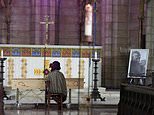
Mourners arrive for state funeral of Desmond Tutu in Cape Town after his death aged 90 on Boxing Day
Anti-apartheid hero Archbishop Desmond Tutu is laid to rest: Mourners attend state funeral in Cape Town after his death aged 90 on Boxing Day
The state funeral of Archbishop Desmond Tutu is being held today, with mourners having arrived all morningThe South African hero and Nobel Peace Prize winner died aged 90 on Boxing Day and will be ‘aquamated’His boy laid in state in St George’s Cathedral, Cape Town, this week for people to pay their respects to him
<!–
<!–
<!–<!–
<!–
(function (src, d, tag){
var s = d.createElement(tag), prev = d.getElementsByTagName(tag)[0];
s.src = src;
prev.parentNode.insertBefore(s, prev);
}(“https://www.dailymail.co.uk/static/gunther/1.17.0/async_bundle–.js”, document, “script”));
<!–
DM.loadCSS(“https://www.dailymail.co.uk/static/gunther/gunther-2159/video_bundle–.css”);
<!–
Mourners arrived this morning at St George’s Cathedral in Cape Town for the funeral service of Archbishop Desmond Tutu, the last great hero in its struggle against apartheid, who died at the end of last week aged 90.
Tutu, a hero of the struggle against apartheid in South Africa, will be laid to rest later today following the official service at the cathedral this morning where for years he preached against racial injustice.
The ceremony started with a hymn and a procession of clerics down the aisle burning incense and carrying candles in the church where Tutu will also be buried.
The requiem mass started at 10am local time (0800 GMT) at the cathedral where, for years, Tutu used the pulpit to rail against a brutal white minority regime. That is where he will be buried.
President Cyril Ramaphosa is expected to deliver the main eulogy for Tutu, whose death on Sunday aged 90 triggered an outpouring of tributes from around the world.
Ramaphosa also accorded Tutu a special category funeral, usually designated for presidents and very important people.
He will also hand South Africa’s multicoloured flag to Tutu’s widow, Leah – a reminder of her husband’s description of the post-apartheid country as the ‘Rainbow Nation’.
For his funeral, Tutu picked as a guiding quote the scripture from the New Testament’s Gospel of St. John where Jesus addresses his disciples after their last supper.
It reads: ‘This is my commandment, that you love one another as I have loved you.’
Mourners have started arriving at St George’s Cathedral in Cape Town this morning for the funeral service of Archbishop Desmond Tutu, who died at the end of last week aged 90. Pictured: Mpho Tutu, one of Desmond’s daughters, sits alone beside his coffin this morning ahead of his funeral
Current Archbishop of Cape Town Thabo Makgoba (left) is seen greeting Leah Tutu (right), the widow of Desmond, this morning inside the cathedral ahead of the funeral
Pictured: Dutch Princess Mabel of Orange-Nassau touches the simple coffin of Desmond Tutu at the St George’s Cathedral in Cape Town, South Africa, this morning
South African president Cyril Ramaphosa arrives at St George’s Cathedral this morning for the state funeral
Guests are seen seated inside St George’s Cathedral, Cape Town, this morning as the funeral service for Desmond Tutu got underway
Pictured: King of Lethoso Letsie III (right) and South Africa President Cyril Ramaphosa (left) are seen stood next to each other at the funeral service
Mpho Tutu is seen taking a moment during her father’s funeral service this morning in South Africa
Under a grey sky and drizzle, mourners were ushered into the cathedral. Rains, according to historian Khaya Ndwandwe ‘are a blessing’ and shows that Tutu’s ‘soul is welcome’ to heaven.
Mourners included close friends and family, clergy and a guests, including former Irish president Mary Robinson, who is to read a prayer.
Others mourners were Elita, the widow of the last apartheid leader FW de Klerk, who died in November.
Conspicously absent from the funeral is one of Tutu’s best friends, the Dalai Lama. He failed to travel due to advanced age and Covid restrictions, his representative Ngodup Dorjee, told AFP outside the church.
Tutu’s longtime friend, retired bishop Michael Nuttall, who was Anglican Church dean when Tutu was the archbishop of Cape Town, will deliver the sermon.
The two forged a strong relationship, illustrating for many how a white leader could work for a black leader. Nuttall went on write a memoir titled ‘Tutu’s Number Two’ about their friendship.
Tutu, awarded the Nobel Peace prize in 1984 for his non-violent opposition to white minority rule, was known for his infectious laugh and easy-going manner but they belied a steely resolve to fight for the downtrodden during the darkest hours of apartheid and beyond into the 21st century.
He died on Boxing Day aged 90. Before his death, the anti-apartheid campaigner had insisted there should be ‘no ostentatiousness or lavish spending’ on the ceremony.
He wanted ‘the cheapest available coffin’ with only ‘a bouquet of carnations from his family’, according to the Archbishop Tutu IP Trust and the Desmond and Leah Tutu Legacy Foundation.
Hundreds of well-wishers queued on Thursday and Friday to pay their last respects to Tutu as he lay in state at the cathedral in a simple, closed pine coffin with rope handles, in accordance with his wishes for a frugal funeral.
Pictured: Members of Desmond Tutu’s family are seen as they carried his casket into St George’s Cathedral this morning during his state funeral
A photo of Archbishop Desmond Tutu stands at the front of the cathedral alongside a large bouquet of flowers
Desmond Tutu’s simple coffin can be seen positioned at the front of the cathedral – it had been his wish that his body be placed in the ‘cheapest available’
Former South African Deputy President Phumzile Mlambo Ngcuka is seen arriving at St George’s Cathedral in Cape Town this morning
Desmond Tutu’s body is set to be aquamated following the funeral service and will be interred in the cathedral
Pictured: The procession prepares itself before the requiem mass of Desmond Tutu begins this morning
As Anglican archbishop of Cape Town, Tutu turned St George’s into a refuge for anti-apartheid activists during the turbulent 1980s and 1990s when security forces brutally repressed the mass democratic movement.
His body will be aquamated in a private ceremony after Saturday’s requiem mass and will then be interred behind the pulpit from where he once denounced bigotry and racial tyranny.
Aquamation – a greener alternative to cremation using water and chemicals – is said to cut the amount of harmful carbon dioxide by up to 90 per cent.
The ‘environmentally friendly’ process involves heating the body in a mixture of potassium hydroxide and water for up to 90 minutes leaving only the bones.
These are then rinsed in the solution at 120C (248F), dried and pulverised into ashes.
The Dean of St George’s Cathedral, the Very Reverend Michael Weeder, said it was what Archbishop Tutu ‘aspired to as an eco-warrior’.
Pictured: The simple coffin of the late Archbishop Desmond Tutu is seen during his state funeral, held this morning in Cape Town, South Africa
Mpho Tutu, one of Desmond Tutu’s daughters, is seen sitting alone at the front of the cathedral this morning ahead of the funeral service
Pictured: The inside of St George’s Cathedral in Cape Town this morning ahead of Desmond Tutu’s funeral service
Pictured: The casket containing the body of Desmond Tutu is seen moments before being carried inside the cathedral
Church bells have tolled daily this week at St George’s in honour of the man often described as South Africa’s ‘moral compass’. Many would refer to Tutu as ‘Tata’ or father.
‘Sometimes strident, often tender, never afraid and seldom without humour, Desmond Tutu’s voice will always be the voice of the voiceless,’ is how long-time friend and former president Nelson Mandela, who died in December 2013, described his friend.
Widely revered across South Africa’s racial and cultural divides for his moral integrity, Tutu never stopped fighting for his vision of a ‘Rainbow Nation’, in which all races in post-apartheid South Africa could live in harmony.
‘Without forgiveness, there’s no future,’ the charismatic cleric once said.
With Nelson Mandela and other leaders sentenced to decades in prison, Tutu in the 1970s became the emblem of the struggle.
The purple-gowned figure campaigned relentlessly abroad, administering public lashings to the United States, Britain and Germany and other countries for failing to slap sanctions on the apartheid regime.
At home, from his pulpit, he slammed police violence against blacks, including the gunning down of school students during the 1976 Soweto uprising. Only his robes saved him from prison.
After apartheid was dismantled and South Africa ushered in its first free elections in 1994, Tutu chaired the Truth and Reconciliation Commission, which exposed the horrors of the past in grim detail.
He would later speak out fearlessly against the ruling African National Congress (ANC) for corruption and leadership incompetence.
Tutu’s moral firmness and passion went hand-in-hand with self-deprecatory humour and a famously cackling laugh.
All week South Africa has been marking a week of mourning for Tutu, with the country’s multi-coloured flag flying at half-mast nationwide and ceremonies taking place every day until the funeral.
Weakened by advanced age and prostate cancer, Tutu had retired from public life in recent years.
He is survived by his wife Leah and four children, and several grand and great grandchildren.
Earlier this week, South Africa announced that the cathedral where Archbishop Emeritus Desmond Tutu preached in Cape Town would ring its bells for ten minutes every day until his funeral.
St. George’s Anglican Cathedral has been honouring the late Nobel Peace Prize laureate with a tribute at midday for the last few days.
South Africans have been laying flowers at the cathedral, in front of Tutu’s home in Cape Town’s Milnerton area, and in front of his former home in Soweto.