

Tsunami warning after earthquake hits northern Japan
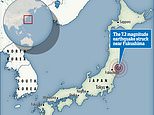
Tsunami warning after 7.3 magnitude earthquake hits Fukushima, causing buildings to rock in Tokyo
The powerful 7.3-magnitude earthquake jolted the east of Japan and left its supermarkets and houses trashedMeanwhile skyscrapers and other buildings in capital Tokyo rocked during the latest quake to hit the countryThe epicentre was off the coast of Fukushima, site of the devastating nuclear disaster in 2011, 37 miles deepShortly after it hit, an advisory for tsunami waves of one metre was issued for Fukushima and Miyagi regions
<!–
<!–
<!–<!–
<!–
(function (src, d, tag){
var s = d.createElement(tag), prev = d.getElementsByTagName(tag)[0];
s.src = src;
prev.parentNode.insertBefore(s, prev);
}(“https://www.dailymail.co.uk/static/gunther/1.17.0/async_bundle- -.js”, document, “script”));
<!–
DM.loadCSS(“https://www.dailymail.co.uk/static/gunther/gunther-2159/video_bundle- -.css”);
<!–
A huge earthquake that rocked buildings and cut power to more than two million homes in Japan has sparked fears of a Tsunami – 11 years after a tidal wave left nearly 19,000 people dead or missing in the same area.
The powerful 7.3-magnitude quake jolted the east of the country and left supermarkets and houses trashed and Tokyo was plunged into darkness amid the electrical shortage on Wednesday night.
The epicentre was off the coast of the Fukushima region – site of the devastating nuclear disaster in 2011 – at a depth of 37 miles.
Shortly after it hit at 11.36pm local time – 2.36pm in the UK – an advisory for tsunami waves of one metre was issued for the coasts of northeastern Fukushima and Miyagi regions.
Japan’s nuclear authority said no abnormalities were detected at the stricken Fukushima plant that went into meltdown 11 years ago.
The site was battered by a 9.0-magnitude quake off the eastern coast on March 11, 2011, triggering a deadly tsunami and nuclear disaster.
Products are scattered at a convenience store in Fukushima, northern Japan Wednesday, March 16, 2022, following an earthquake
Furniture and electrical appliance are scattered at an apartment in Fukushima, northern Japan Wednesday, after a 7.3 magnitude earthquake struck
The earthquake triggered a huge power cut which left this block of flats in Koto district in Tokyo in darkness today
Prime Minister Fumio Kishida told reporters the government was gathering information on the situation. Pictured: The electrical shortage in Toshima ward in Tokyo
Japan’s capital city Tokyo was left in eerie darkness as the power was cut to two million people following the latest earthquake to hit the country
A 20 centimetre tsunami wave was recorded in Ishinomaki in Miyagi prefecture overnight, according to public broadcaster NHK, which showed images of some structural damage in Fukushima.
Government spokesman Hirokazu Matsuno said: ‘Calls have been inundating police and ambulances in Fukushima and Miyagi. We’re doing our best to assess the extent of the damage.’
Matsuno said an emergency government taskforce had been set up and warned residents of possible strong aftershocks over the next week.
He added: ‘Major aftershocks often happen a couple of days after the first quake, so please stay away from any collapsed buildings … and other high-risk places.’
At least two million households were left without power in the central Kanto region, including 700,000 in Tokyo, electricity provider TEPCO said.
An apartment is upturned by the violent earthquake that rocked Japan earlier today
An employee clears products fallen from shelves at a convenience store in Iwaki, Fukushima prefecture, northern Japan Wednesday
People walk on a street during a black out in Tokyo in the early hours of Thursday after the earthquake on Wednesday night
People in Tokyo make a line to wait for taxis in Sendai, Miyagi prefecture, northern Japan early on Thursday morning
Japanese Prime Minister Fumio Kishida is pictured speaking during a news conference in Tokyo amid the chaos caused by the quake
In the northeast, 156,000 households had no power, regional energy company Tohoku Electric Power said.
Prime Minister Fumio Kishida said the government was gathering information on the situation.
He said: ‘We will commit ourselves to gathering information, do our best to rescue those affected by the (quake) and communicate information appropriately.’
Regional train company JR East said it was experiencing significant disruption to its operations.
Japan sits on the Pacific ‘Ring of Fire’, an arc of intense seismic activity that stretches through Southeast Asia and across the Pacific basin.
The country is regularly hit by quakes, and has strict construction regulations intended to ensure buildings can withstand strong tremors.
But it remains haunted by the memory of the 2011 undersea quake in northeastern Japan that triggered a deadly tsunami and unleashed the Fukushima nuclear accident.
A minute’s silence was held on Friday, the anniversary of the disaster, to remember the some 18,500 people left dead or missing in the tsunami.
Around the stricken Fukushima plant, extensive decontamination has been carried out, and this year five former residents of Futaba, the region’s last uninhabited town, returned to live there on a trial basis.
Around 12 percent of Fukushima was once declared unsafe but no-go zones now cover just 2.4 percent of the prefecture, although populations in many towns remain far lower than before.
People shop in darkness in a store in a residential area during the power outage in Koto district in Tokyo on Wednesday evening
Houses and buildings are seen in an electric stoppage at Toshima ward in Tokyo after the huge earthquake shook the capital late Wednesday